 KarpiGames Editorial
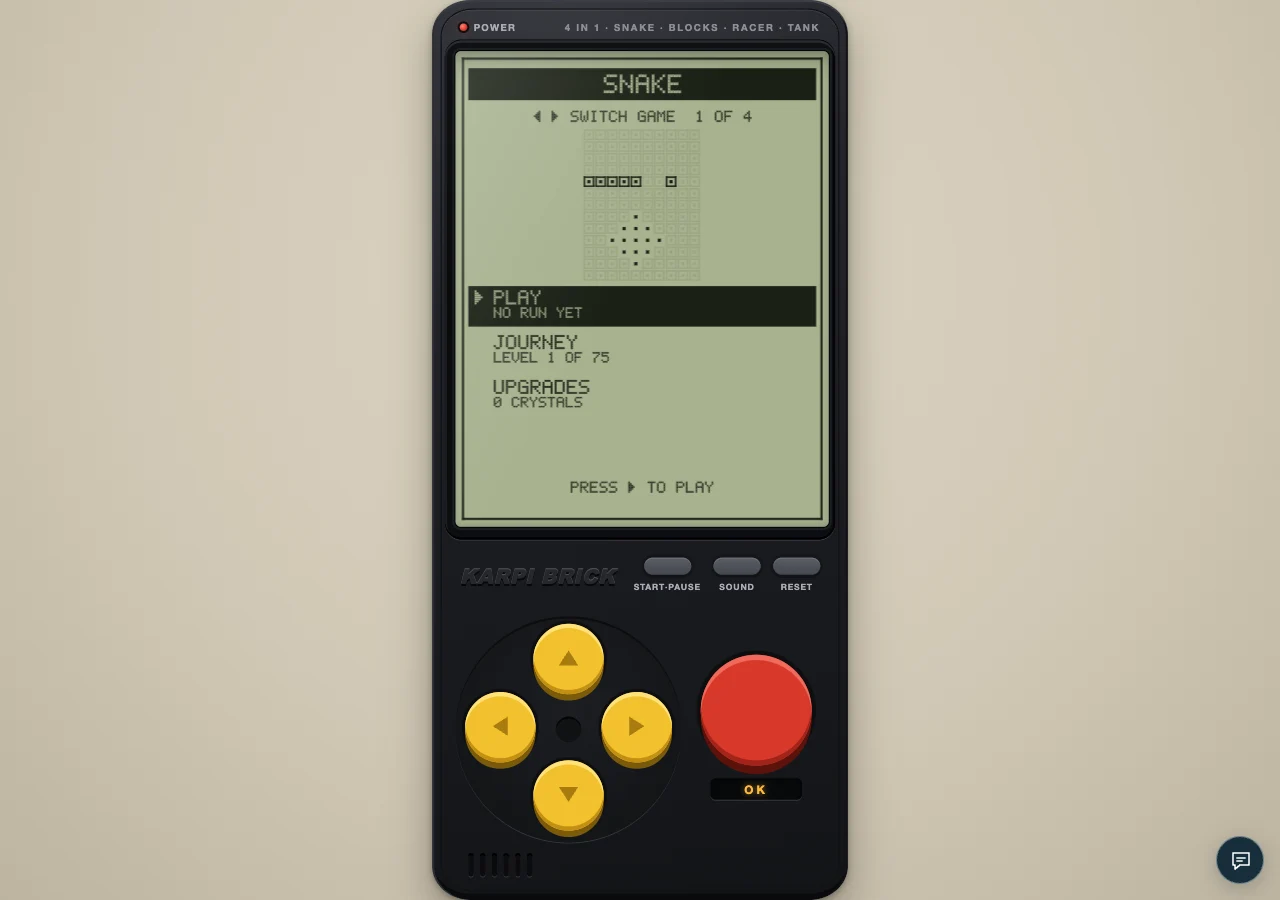
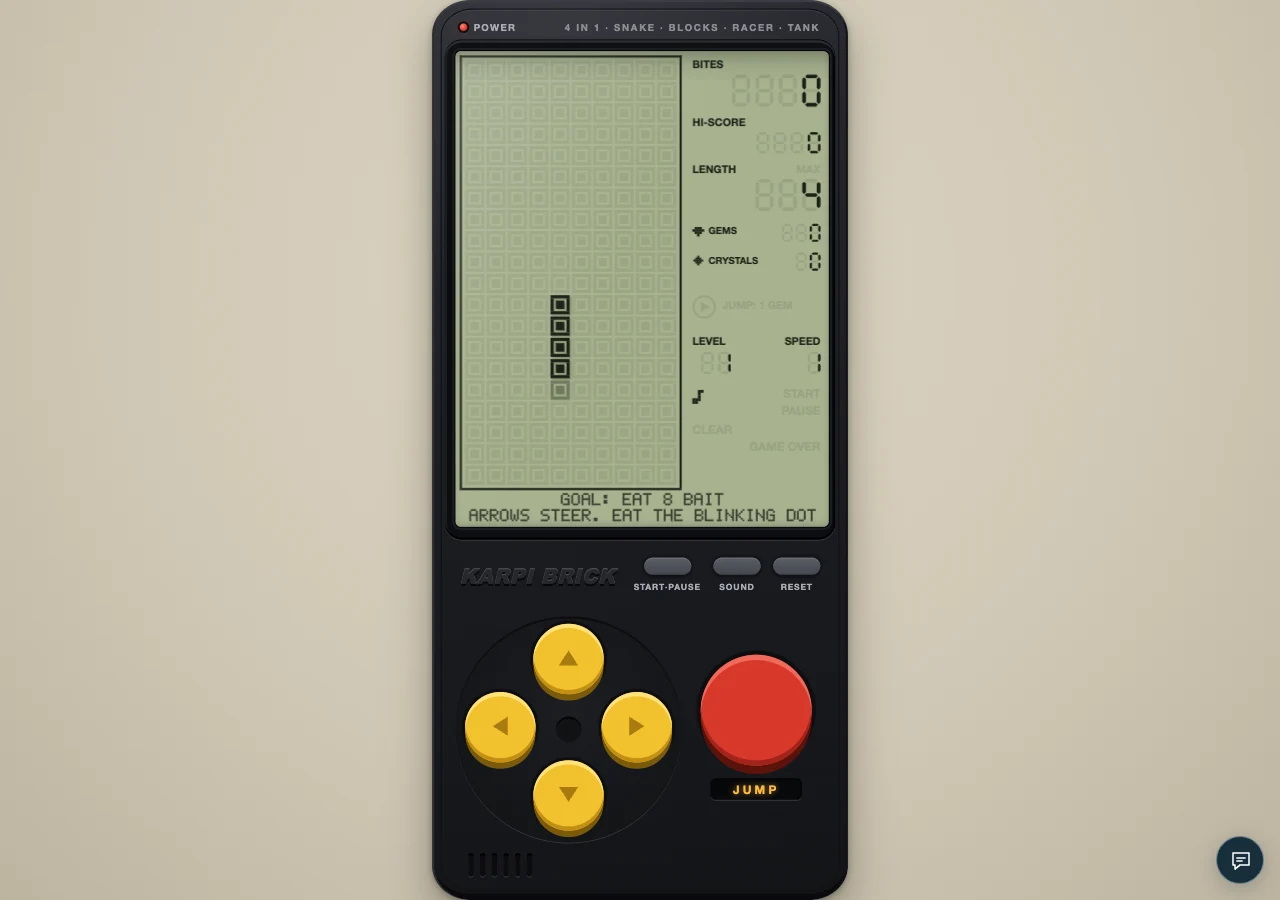
An authentic local capture of the cartridge. The visual guides below explain the decisions to look for.
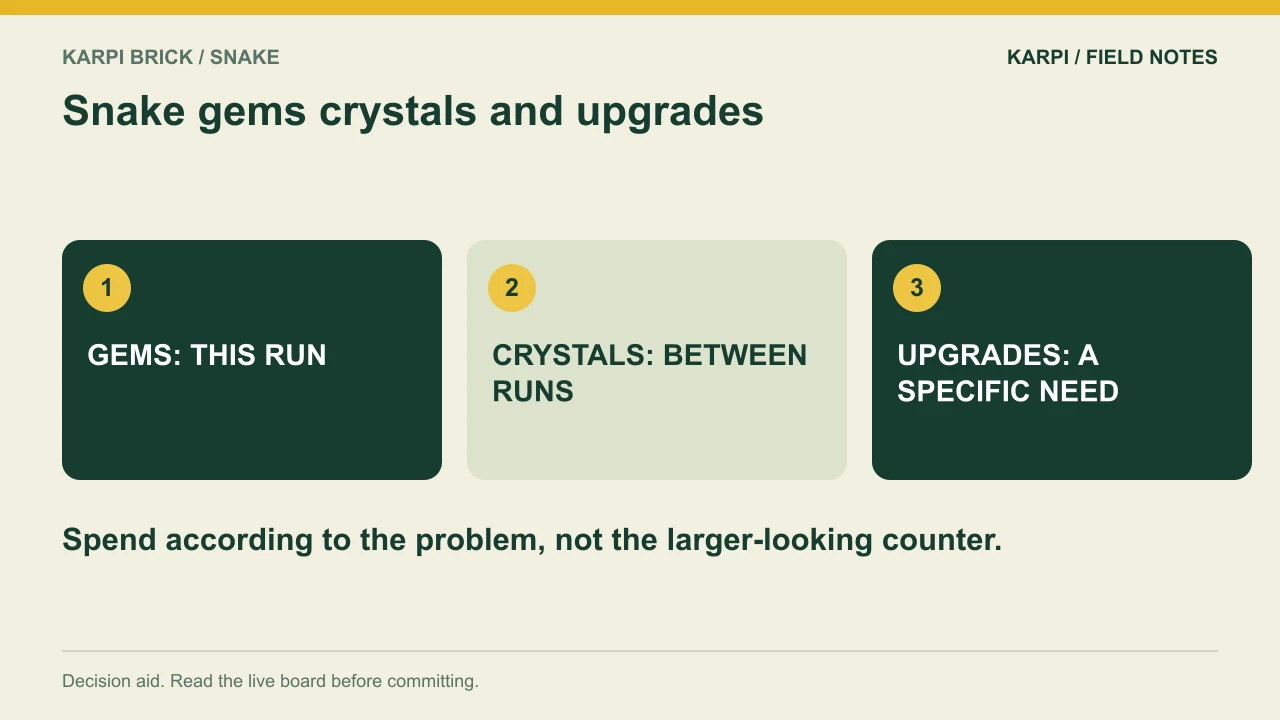
Snake has two different resources. Gems belong to the current run and pay for time jumps. Crystals persist between runs and buy Snake upgrades. Understanding that distinction makes the console's counters and upgrade menu much easier to read.
Gems are a tool for this run
Every bite adds a gem in the base rules. A time jump spends gems to shorten a suitable straight approach to bait. Those gems do not become a permanent upgrade balance at the end of the run. Use them to solve the current board, while remembering that the action has a cost and needs a target ahead. Saving every gem is not automatically better play.
Crystals support later attempts
Crystals can appear during Snake runs, and journey levels carry one-time opportunities. They are the persistent resource used in the upgrade menu. The other console cartridges also have their own ways of contributing to the shared crystal balance. Treat a crystal as a separate route decision: reaching it is useful only if the detour still leaves you able to finish the attempt you care about.
Choose an upgrade for a recurring problem
The upgrade categories include longer segment life, a lower jump cost, starting gems, free jumps and greater crystal pickup reach. Read the current menu before spending. A player who repeatedly runs out of body time has a different problem from someone who rarely uses the jump. Select the upgrade that supports a strategy you actually use, rather than buying a category because its name sounds strongest.
An upgrade does not remove the basic rules
More forgiving resources still leave the body, walls and route choices in place. If the same corner keeps ending a run, changing that route is more direct than expecting progression to solve it. Practice-style fixed deals can also use different upgrade conditions from an ordinary run. Compare like with like when judging whether a change helped.
Compare upgrades on a familiar route
Suppose you repeatedly reach food a little too late on the same long circuit. A segment-life upgrade may provide more margin, but a shorter wrap route could address the cause directly. Try the route change first so you know what the upgrade would add. Now suppose your routes are sound but a planned early jump is unavailable because the run has not yet earned enough gems. Starting-gem or free-jump categories relate more directly to that strategy. These are examples of matching a tool to a problem, not a universal purchase order. The current menu shows the available level and cost for your progress. Keep those live details as the source of truth. A useful purchase should make a recognisable plan easier to execute; it should not be the only explanation you have for why the next run might improve.
A focused practice attempt
Review your last few endings before opening UPGRADES. Write down the repeated cause, then match it to one relevant upgrade category—or decide the problem is a route that needs practice. After buying anything, play the same familiar level so the comparison is clearer than jumping straight into a new challenge.
At the console | What to use |
|---|---|
Open this cartridge | |
Main controls | Arrows or WASD steer; Space uses JUMP. The four edges wrap. |
Pause | START/PAUSE on the console; Enter or P on a keyboard |
Journey | 75 levels across eight chapters; read the goal and two extras |
Take it to the board: Play Snake and test one decision from this guide. The advice describes the current cartridge rules; a practice exercise is not a guaranteed score or clear.
 Take it to the gameBrick GameSnake, Blocks, Racer and Tank on a 90s handheldPlay free
Read next
Snake on a Phone: Stop Oversteering the Corners For the series starting point, read Karpi Brick Snake: The Tail Is a Clock.