 KarpiGames Editorial
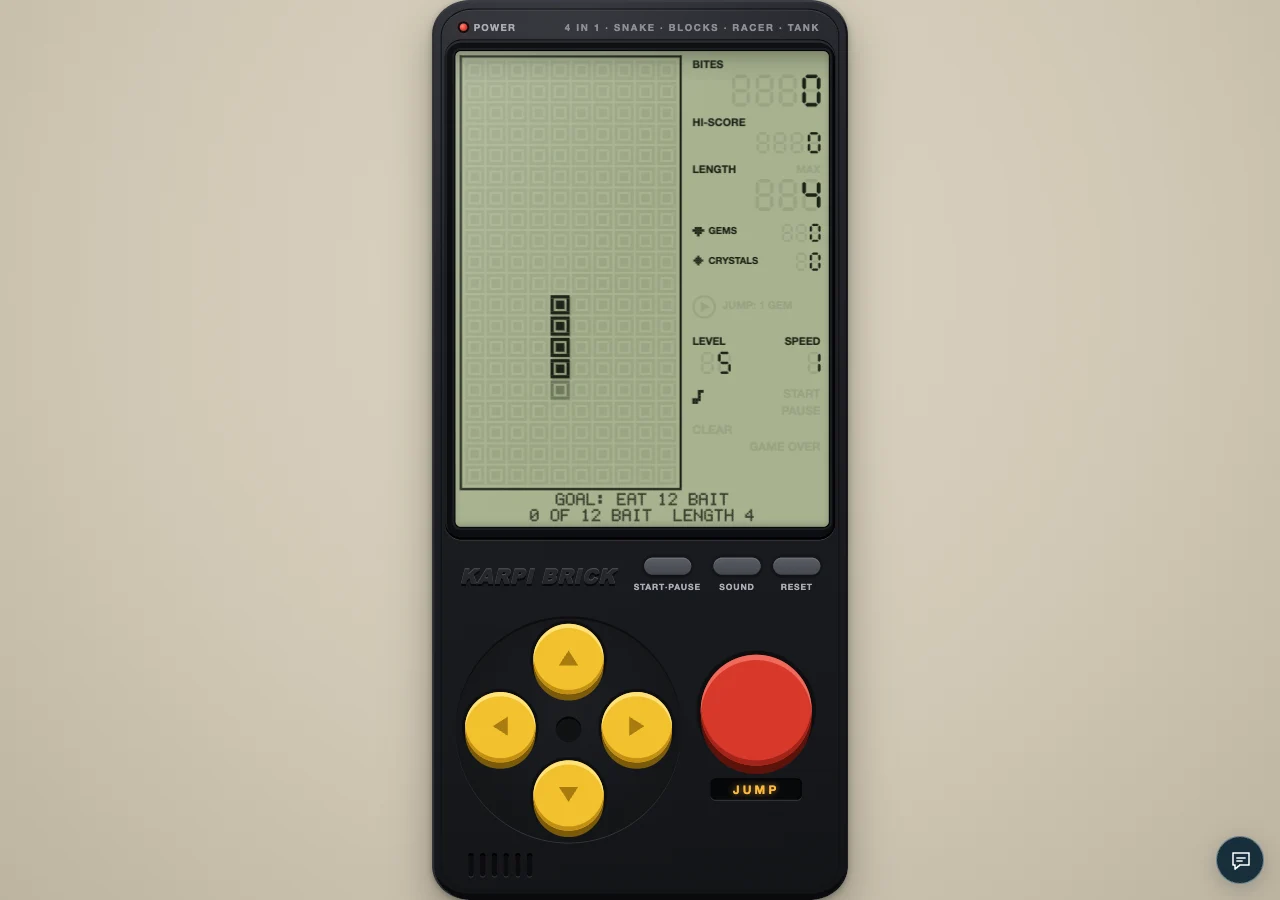
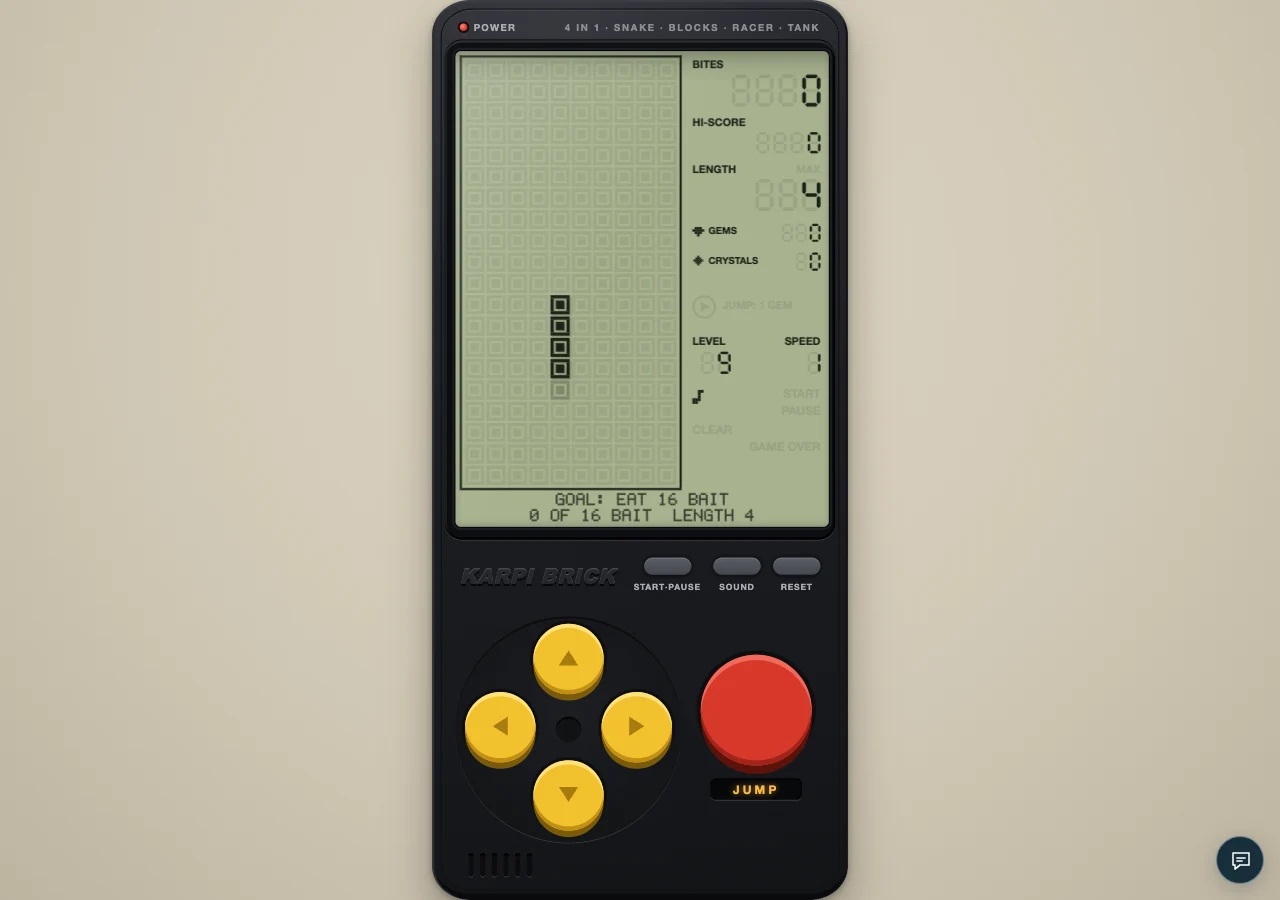
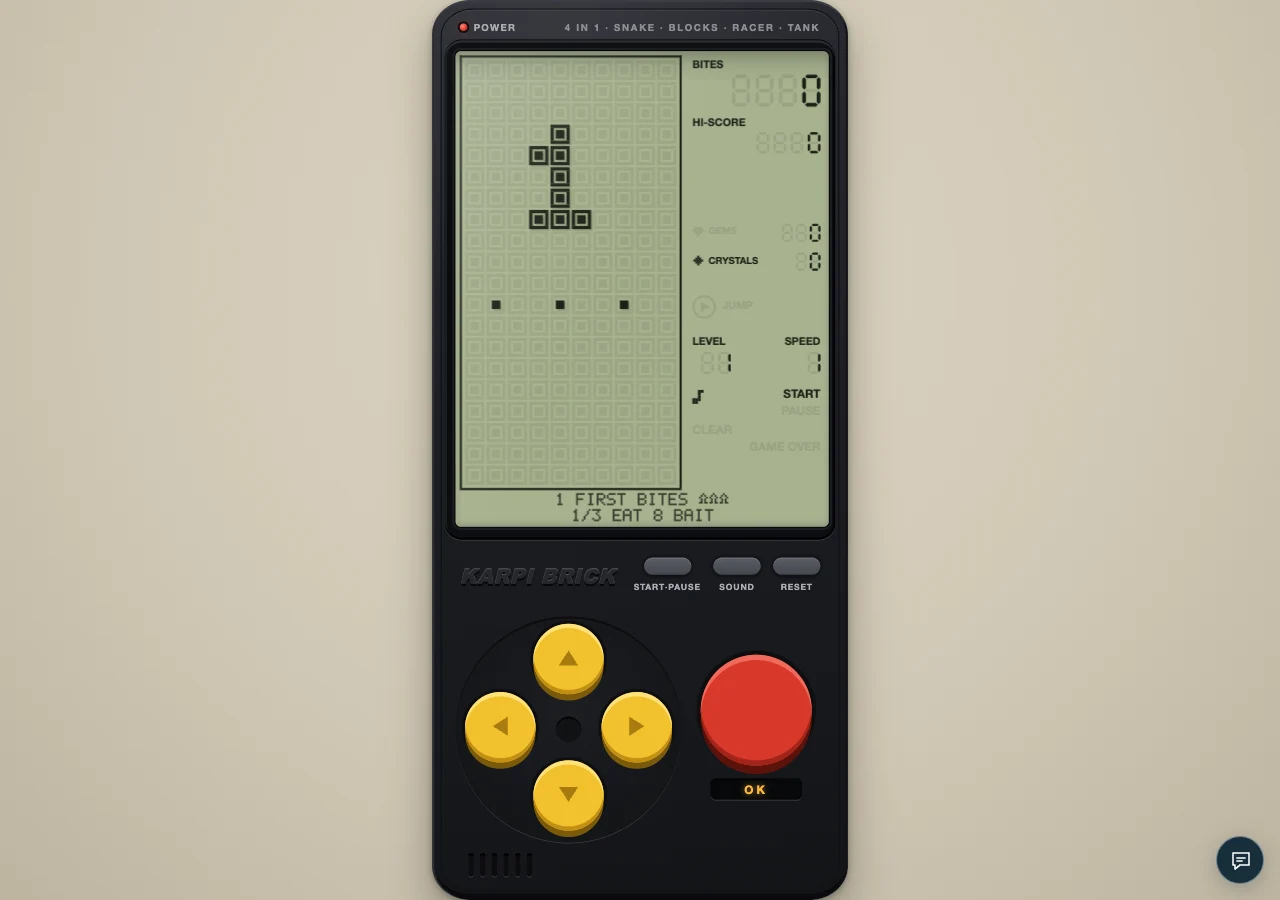
An authentic local capture of the cartridge. The visual guides below explain the decisions to look for.
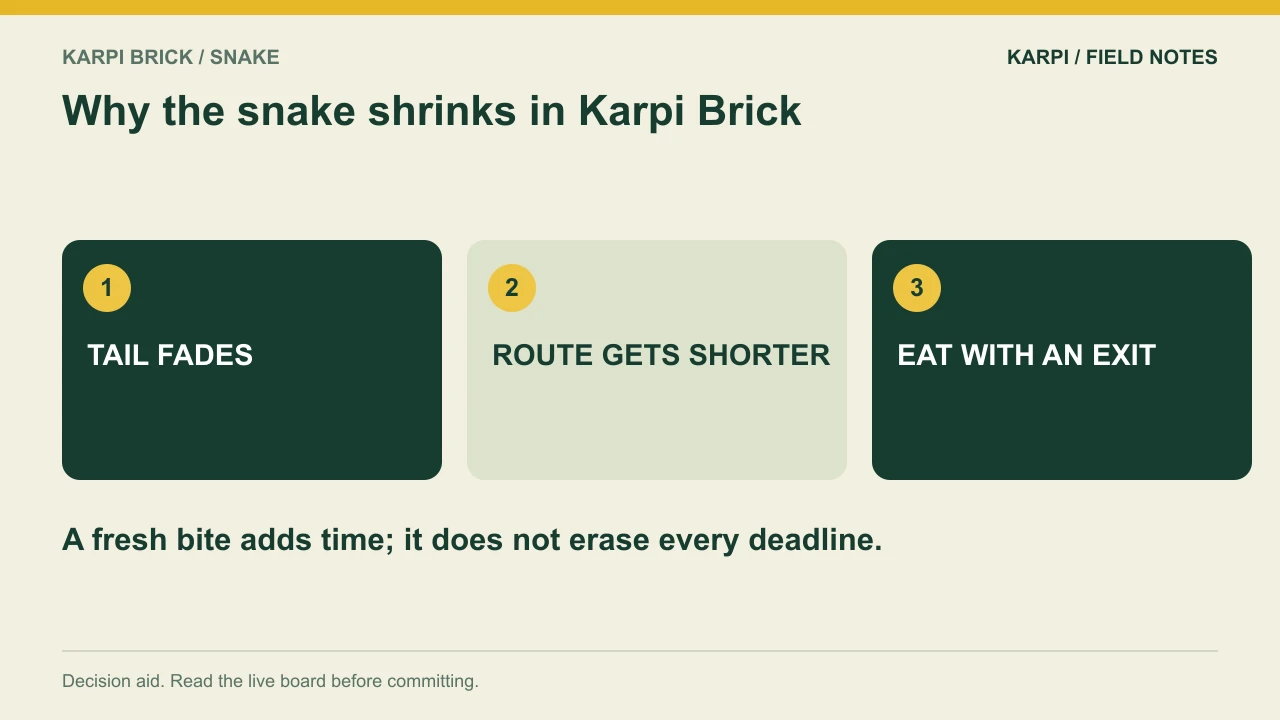
A shrinking snake is part of the rules. Each body segment has a lifetime, and uneaten food cannot renew it from across the board. Survival means keeping a useful flow of bites without growing into your own escape route.
Length and time are different resources
A long body can look reassuring, but its oldest segments may already be close to expiry. Conversely, a short body with fresh segments can have time for a controlled turn. Read the fading tail together with the distance to food. Length alone is an incomplete warning light. You are managing where the body sits and how much of it will still exist when the head arrives.
The oldest segment is the next deadline
The tail warning gives you a near-term problem to solve. If food is close, keep the approach simple. If it is far away, compare both wrap directions before committing to a large circuit. A detour that was harmless several bites ago may be too expensive now. There is no benefit in preserving an elegant route if the last body segment expires before the next meal.
A bite does not reset the whole snake
Eating adds a segment with its own lifetime; it does not make every existing segment young again. This is why a burst of food and a long pause can still end badly. A steadier rhythm is easier to read. New segment lifetimes also grow over the course of a run, so the space occupied by a successful snake can become a bigger challenge even while the movement speed stays fixed.
Avoid solving hunger with a trap
A straight line to food is attractive when the tail is blinking. Check the cell after the bite too. If the food sits beside a wall or inside a narrow pocket, entering may leave no safe turn once the body grows. Sometimes the better line is a slightly longer approach that points the head toward open space. The important comparison is between complete routes, not distances to the food alone.
Diagnose a run that ends in open space
If the run ends with no wall or body immediately ahead, review the tail rather than assuming an invisible collision. You may have completed a safe-looking loop while the last segment expired. An open board removes some collision pressure, but it does not suspend hunger. On the next attempt, watch the earliest warning and compare it with the nearest reachable food. Also distinguish a bait disappearing from a segment disappearing: the former changes your route target, while the latter reduces your remaining body. Chasing the place where food used to be wastes moves. A successful correction is observable before the score improves: you notice the deadline earlier, abandon an obsolete route sooner and arrive at an actual bait with an exit still available. Those are better signs of learning than one unusually long run.
A focused practice attempt
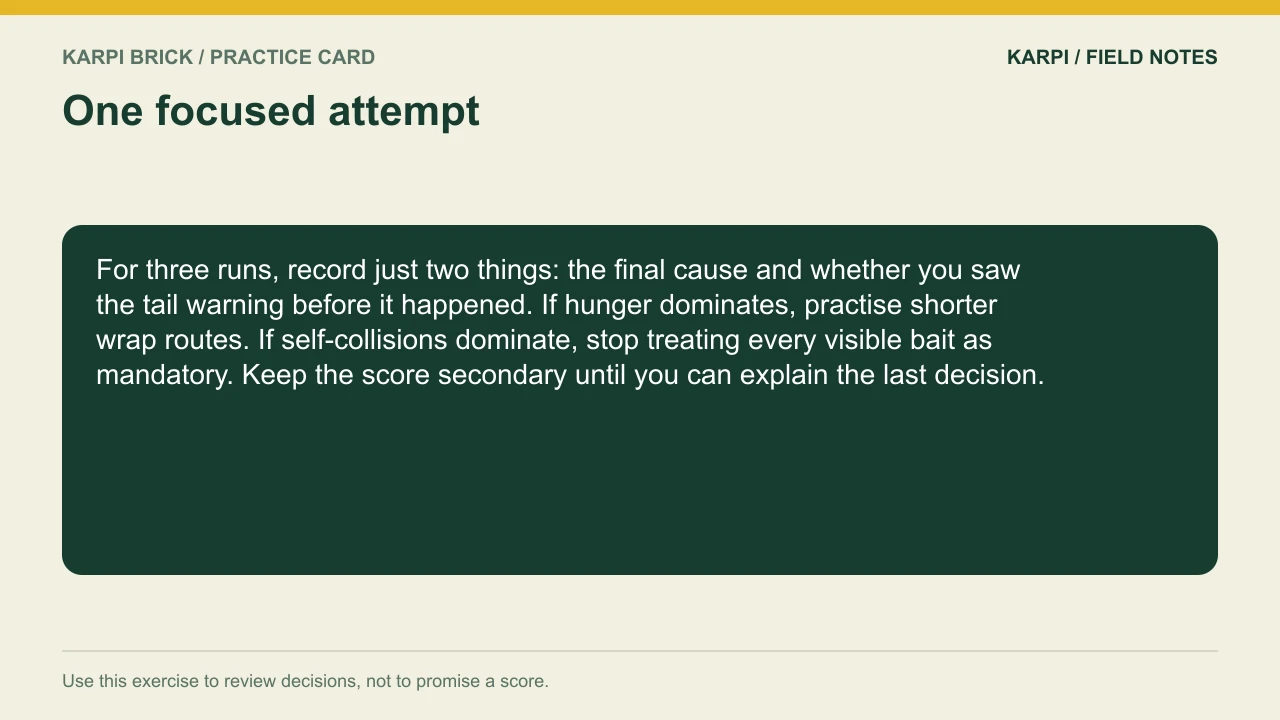
For three runs, record just two things: the final cause and whether you saw the tail warning before it happened. If hunger dominates, practise shorter wrap routes. If self-collisions dominate, stop treating every visible bait as mandatory. Keep the score secondary until you can explain the last decision.
At the console | What to use |
|---|---|
Open this cartridge | |
Main controls | Arrows or WASD steer; Space uses JUMP. The four edges wrap. |
Pause | START/PAUSE on the console; Enter or P on a keyboard |
Journey | 75 levels across eight chapters; read the goal and two extras |
Take it to the board: Play Snake and test one decision from this guide. The advice describes the current cartridge rules; a practice exercise is not a guaranteed score or clear.
 Take it to the gameBrick GameSnake, Blocks, Racer and Tank on a 90s handheldPlay free
Read next
Snake Wraparound Routes: The Edge Is Your Shortcut For the series starting point, read Karpi Brick Snake: The Tail Is a Clock.