 KarpiGames Editorial
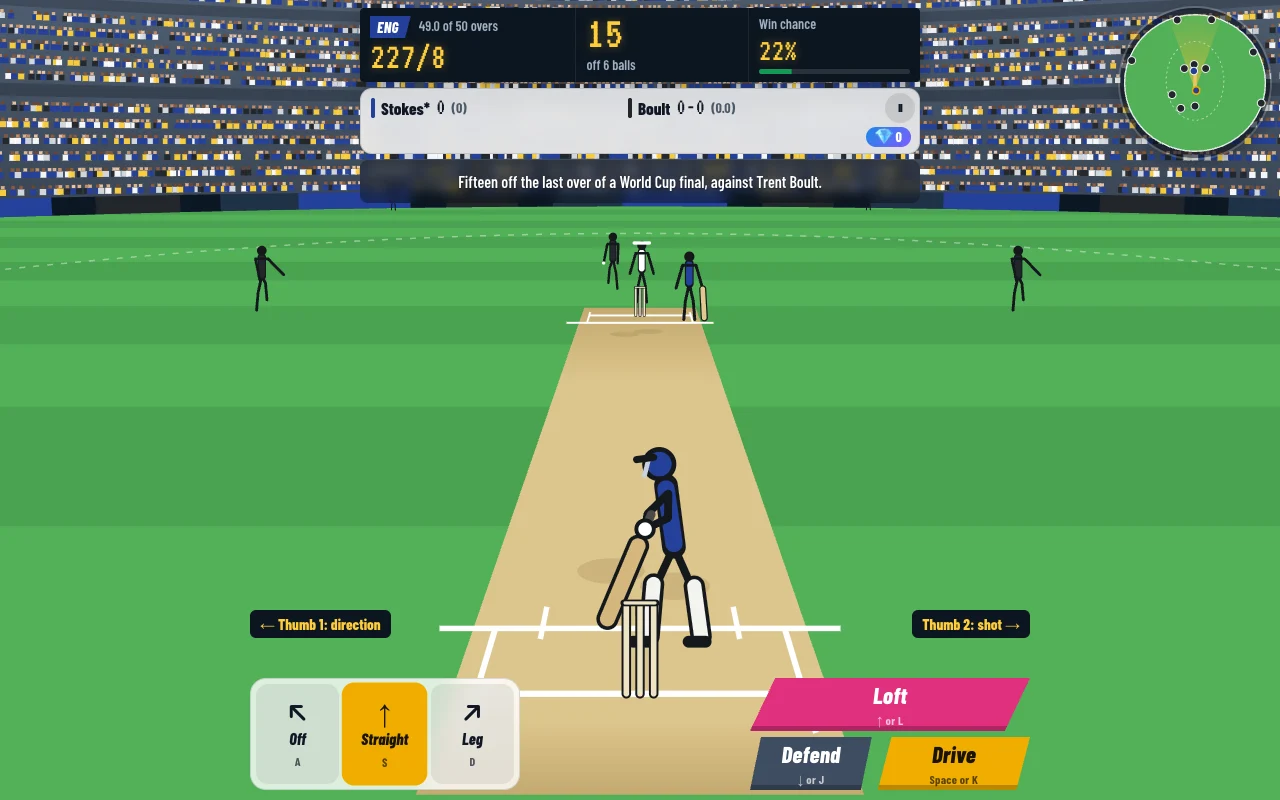
Game recreation captured locally; this is not an archival match photograph.
The 2019 World Cup final reached its last over, then a Super Over, and still refused to produce different scores. Ben Stokes' finish at Lord's is a story about a chase that survived extraordinary turns without becoming an ordinary victory.
What happened in the real match
England were chasing 242 against New Zealand. Stokes and Jos Buttler rebuilt the innings, and Stokes finished unbeaten on 84. The main match ended level after a final over that included a six and a throw deflecting off Stokes' bat to the boundary. The Super Over was also tied; England were awarded the title under the boundary-count rule used for that tournament. That is the historical result, not a rule to assume for every cricket match today. ICC's 2019 World Cup final report.
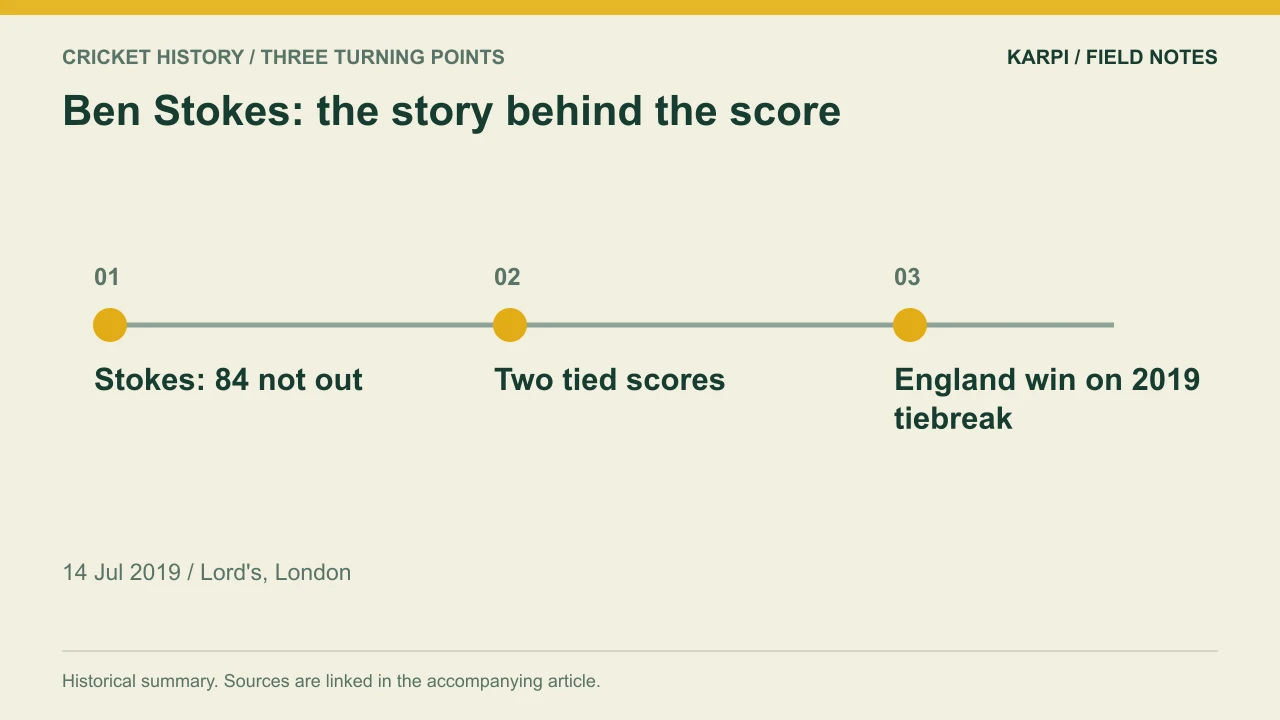
A historical outcome is not a repeatable tactic
The deflection belongs to the match's extraordinary sequence, but it is not a batting instruction. A player cannot plan to receive that precise event. The more useful replay question is what can be controlled: choosing a scoring direction, timing contact and updating the target. This separates remembering an incident from pretending it is a dependable route through a chase.
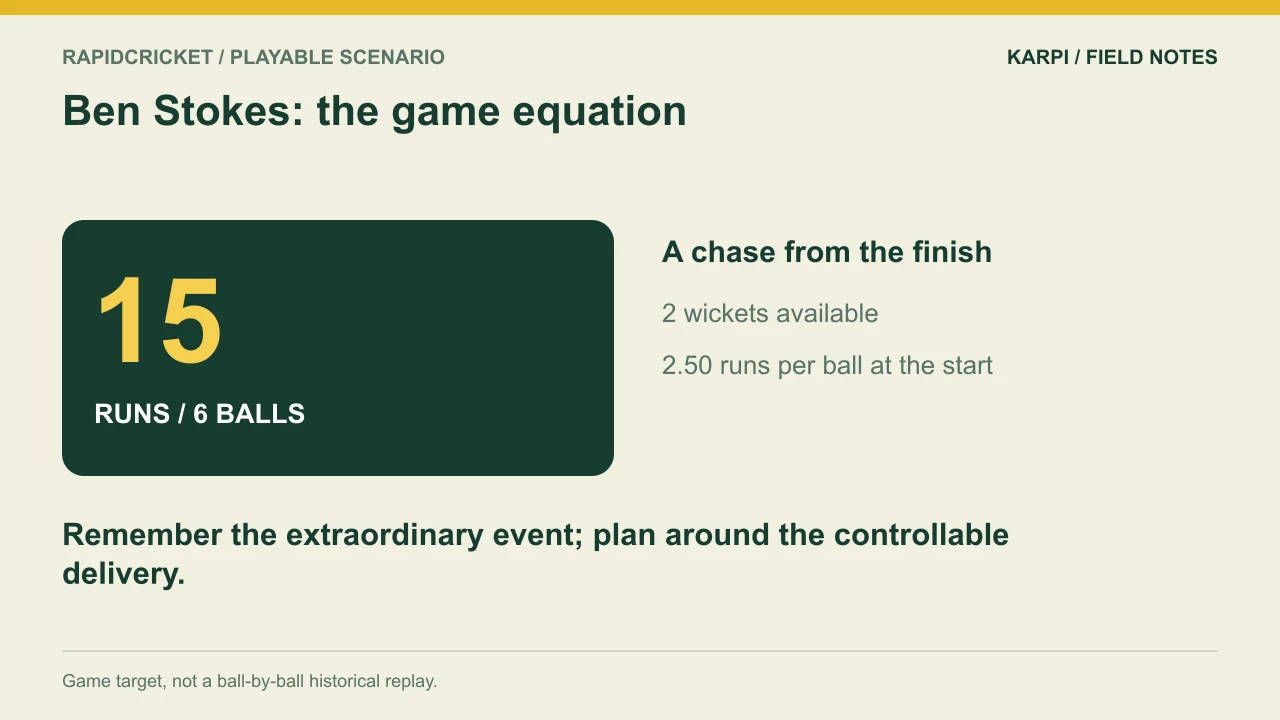
Step into the game scenario
The game begins at fifteen from six against Trent Boult, with two wickets available. Seek a workable scoring sequence using the actual field and deliveries. The recreation does not require or promise the same overthrow incident, tied Super Over or boundary-count resolution. Treat its target as a game challenge inspired by the last over. A replay can end differently without contradicting the historical story.
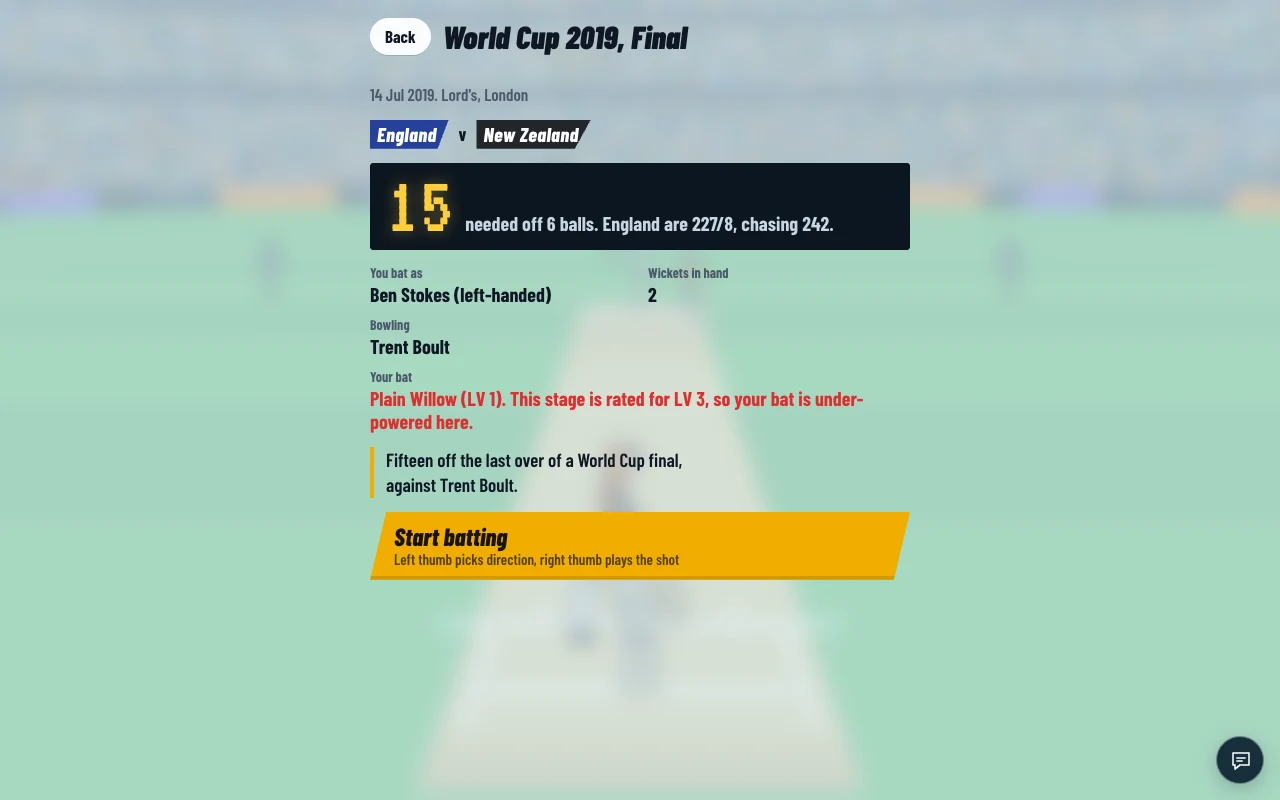
In this game challenge | Starting value |
|---|---|
Target | 15 runs in 6 balls |
Format | Chase inspired by the finish |
Wickets available | 2 |
Rated bat level | 3 |
Before the first ball
The left controls choose leg, straight or off; the right controls choose defend, drive or loft. The brief shows your equipped bat against the scenario's rating. A lower-rated bat can make a demanding boundary target harder, so use that information when judging a missed attempt. The numbers in the table are the game's starting conditions; its lives, delivery sequence and progression are not a historical scorecard.
Play one attempt with a boundary plan and one with a more selective approach after the first scoring shot. Compare whether your decisions responded to the changing target or to the outcome you already knew from history.
Try this finish: Play the Ben Stokes scenario. If it is ahead of your career progress, the link opens an exhibition: you use your own bat and kit, and it does not advance the career or award diamonds. An already-open stage follows normal career rules.
 Take it to the gameRapidCricketReal last-over finishes, two thumbsPlay free
Read next
Jadeja's 2023 Final: Ten Off Two, Then Six and Four For the series starting point, read Dhoni's 2011 World Cup Six: Four Runs From History.