 KarpiGames Editorial
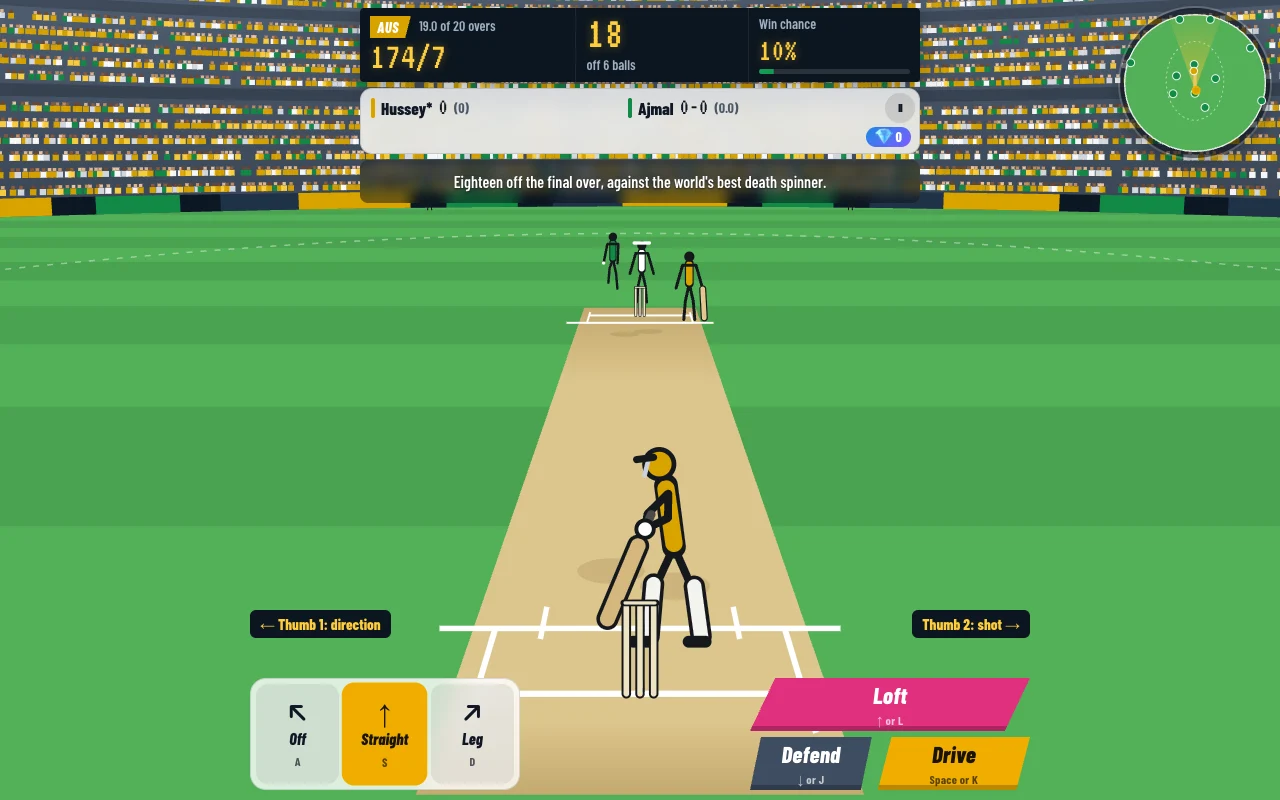
Game recreation captured locally; this is not an archival match photograph.
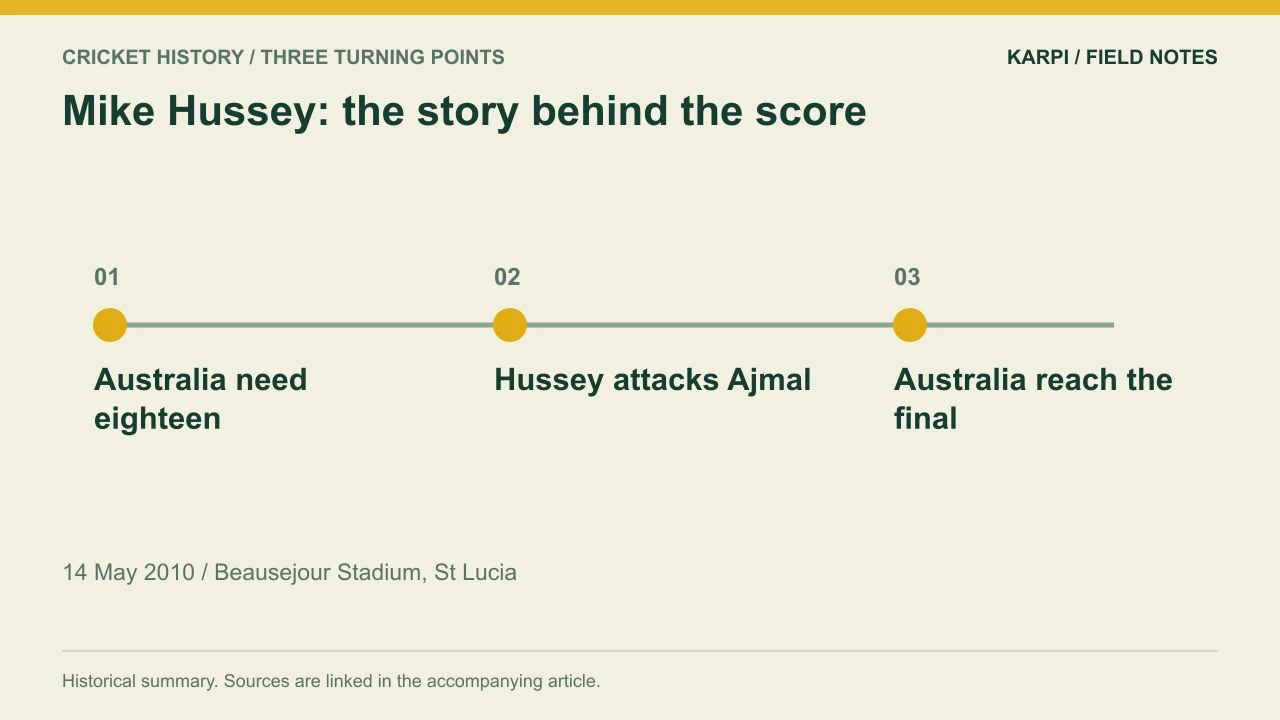
Australia needed eighteen from the last over of the 2010 World T20 semi-final. Mike Hussey turned Saeed Ajmal's over into an escape route, finishing a chase that had looked beyond Australia only moments earlier.
What happened in the real match
Hussey made an unbeaten 60 from 24 balls against Pakistan in St Lucia on 14 May 2010. Australia entered the final over needing eighteen; a succession of boundary blows took the chase home with one delivery left. Cricket Australia's retrospective records twenty-two runs from that five-ball final-over burst. The innings sent Australia into the final and made a familiar batting label—finisher—feel much too small for the situation. Cricket Australia's retrospective on Hussey's finish.
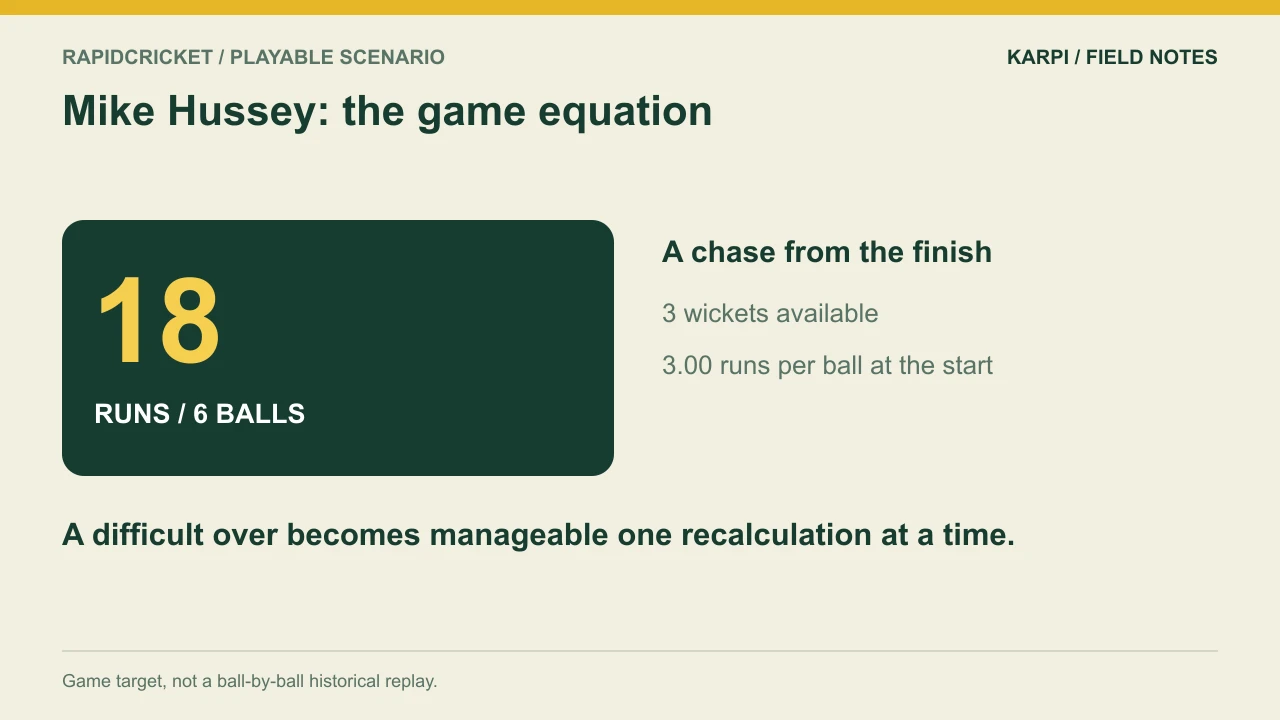
The target is steep, but not a six-every-ball demand
Eighteen from six averages three per ball. That is urgent without requiring a maximum from every delivery. A boundary can buy room for another kind of scoring shot; a dot can make the next boundary more important. The scenario is interesting because it rewards updating the plan rather than choosing either total caution or six identical swings before the over begins.
Step into the game scenario
The game starts at eighteen from six against Ajmal with three wickets available. Read the spinner's arrival instead of reusing a pace-bowling rhythm. Choose the direction from the field and let timing feedback guide the next delivery. If you get a boundary early, check the revised target. The historical outcome is inspiration; your attempt still has to solve the game's actual six-ball sequence.
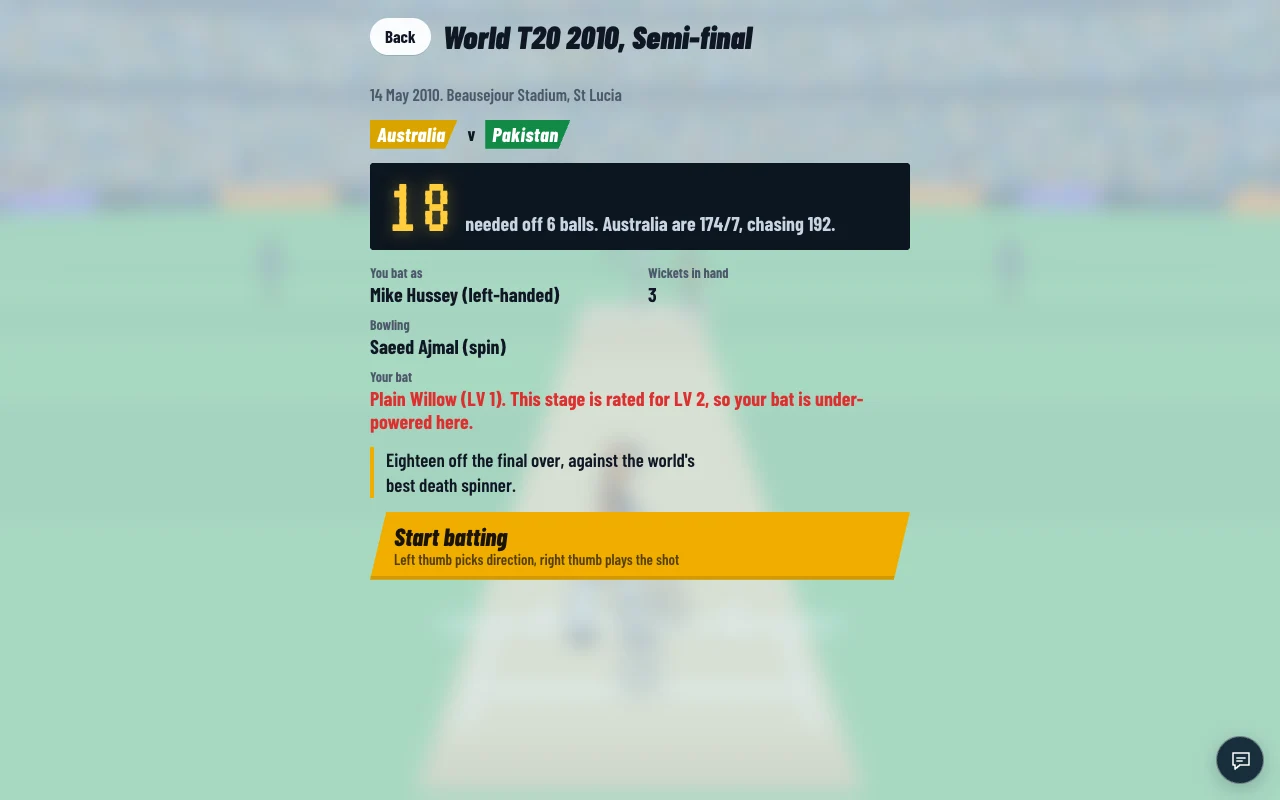
In this game challenge | Starting value |
|---|---|
Target | 18 runs in 6 balls |
Format | Chase inspired by the finish |
Wickets available | 3 |
Rated bat level | 2 |
Before the first ball
The left controls choose leg, straight or off; the right controls choose defend, drive or loft. The brief shows your equipped bat against the scenario's rating. A lower-rated bat can make a demanding boundary target harder, so use that information when judging a missed attempt. The numbers in the table are the game's starting conditions; its lives, delivery sequence and progression are not a historical scorecard.
After every ball, state the runs needed and balls left before choosing the next shot. On a replay, compare whether your response to a dot was a better plan or simply a hurried swing.
Try this finish: Play the Mike Hussey scenario. If it is ahead of your career progress, the link opens an exhibition: you use your own bat and kit, and it does not advance the career or award diamonds. An already-open stage follows normal career rules.
 Take it to the gameRapidCricketReal last-over finishes, two thumbsPlay free
Read next
Dhoni's 2011 World Cup Six: Four Runs From History For the series starting point, read Dhoni's 2011 World Cup Six: Four Runs From History.