 KarpiGames Editorial
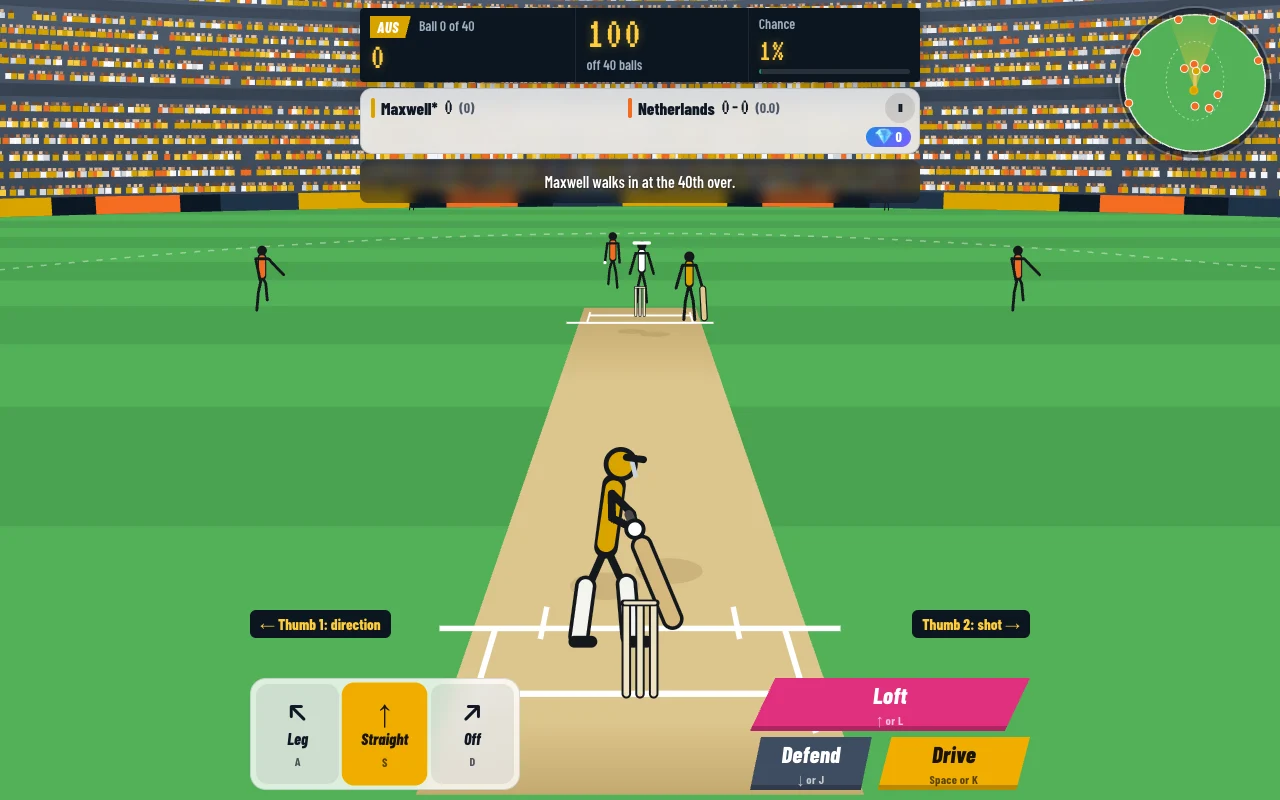
Game recreation captured locally; this is not an archival match photograph.
Glenn Maxwell's hundred against the Netherlands in Delhi did not belong to a last-over chase. It belonged to the other kind of batting pressure: how much damage can be done before the innings runs out of deliveries?
What happened in the real match
On 25 October 2023, Maxwell reached a century from forty balls at the men's ODI World Cup, breaking the tournament mark set earlier in that edition by Aiden Markram. The innings came against the Netherlands in Delhi. Contemporary accounts describe a burst that accelerated sharply through its second half, turning limited time at the crease into a new tournament record. It was a distinct performance from Maxwell's later double-century against Afghanistan in the same World Cup. ICC's report on Maxwell's Delhi century.
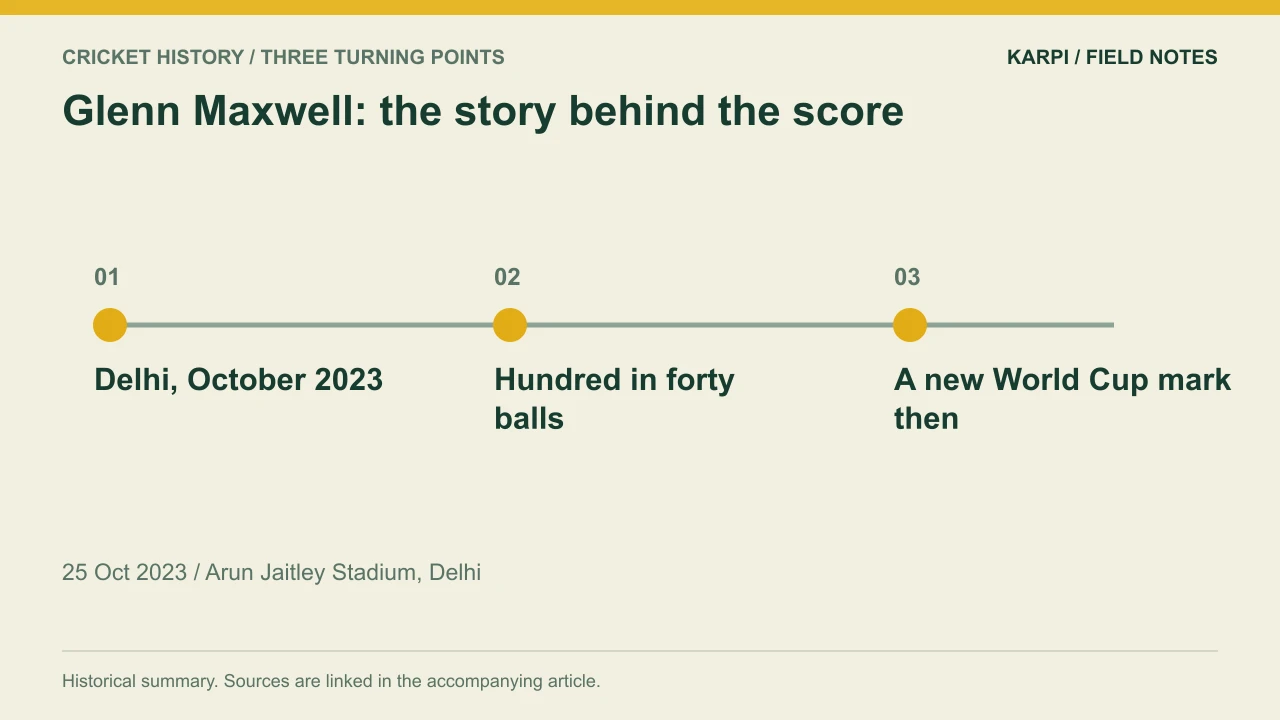
Not every famous innings is a chase
The game's feat format makes the distinction useful. You are pursuing a run milestone within a ball allowance, rather than overtaking an opposition total from a specific team score. That changes the story you should tell yourself while playing. There is no need to invent a final-over rescue around a record that came from setting a total. The pressure is sustained scoring against a closing clock.
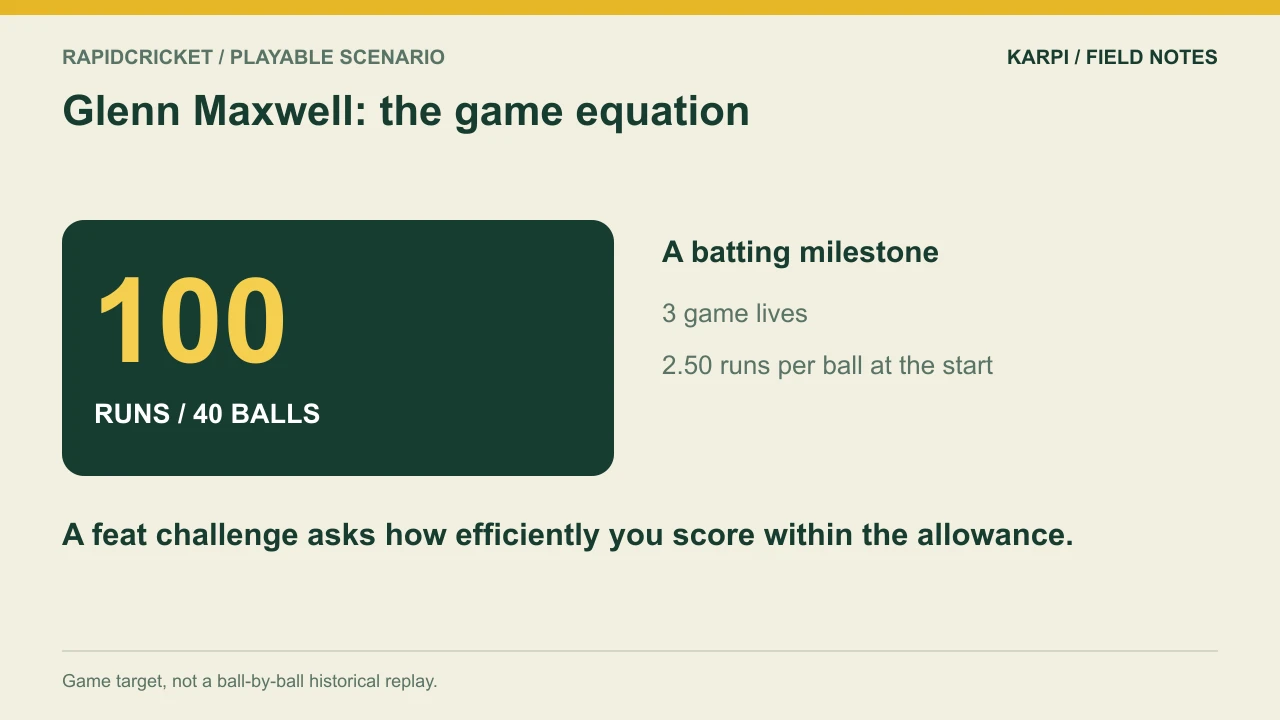
Step into the game scenario
The challenge is one hundred from forty balls with three game lives, facing Netherlands pace and spin. A two-and-a-half-runs-per-ball average is a reference, not a command to play the same stroke each time. Watch the next delivery, choose a gap or boundary direction, and update the target after contact. If you fall behind, look for the repeated source of dots before assuming more aggressive button pressing is the answer.
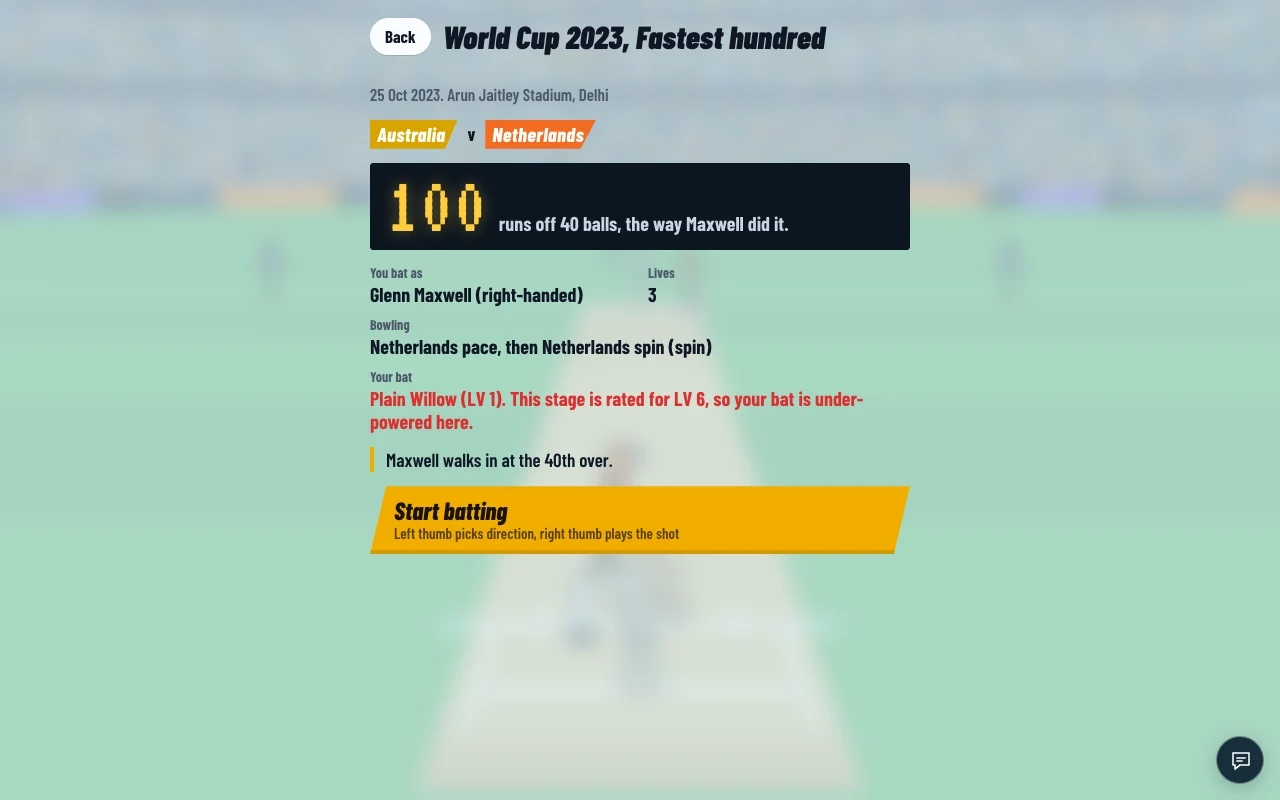
In this game challenge | Starting value |
|---|---|
Target | 100 runs in 40 balls |
Format | Batting feat inspired by the innings |
Game lives | 3 |
Rated bat level | 6 |
Before the first ball
The left controls choose leg, straight or off; the right controls choose defend, drive or loft. The brief shows your equipped bat against the scenario's rating. A lower-rated bat can make a demanding boundary target harder, so use that information when judging a missed attempt. The numbers in the table are the game's starting conditions; its lives, delivery sequence and progression are not a historical scorecard.
Split the attempt into four ten-ball blocks and review each block's scoring and wickets. On the replay, focus on the weakest block's timing pattern rather than trying to force an enormous first over.
Try this finish: Play the Glenn Maxwell scenario. If it is ahead of your career progress, the link opens an exhibition: you use your own bat and kit, and it does not advance the career or award diamonds. An already-open stage follows normal career rules.
 Take it to the gameRapidCricketReal last-over finishes, two thumbsPlay free
Read next
Wade's Three Sixes: Australia's Semi-Final Turns in an Over For the series starting point, read Dhoni's 2011 World Cup Six: Four Runs From History.