 KarpiGames Editorial
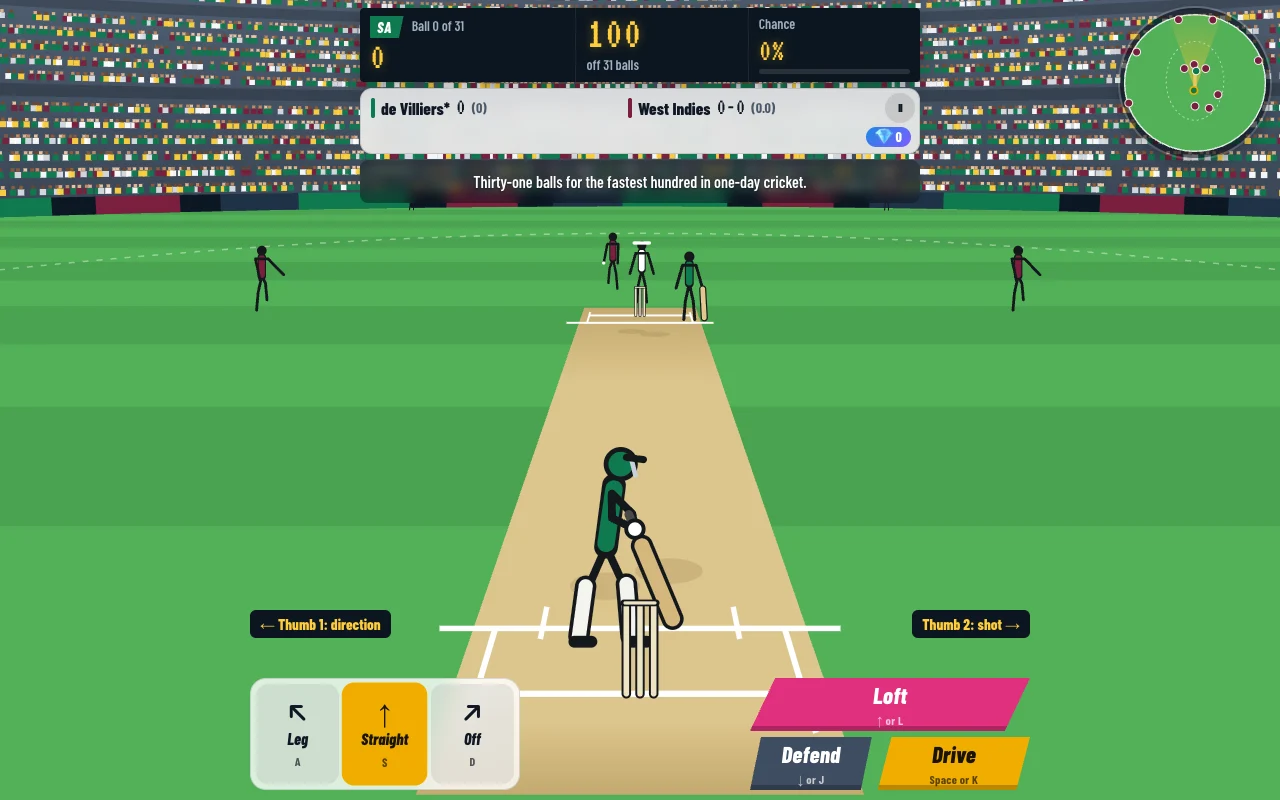
Game recreation captured locally; this is not an archival match photograph.
AB de Villiers arrived late enough for an ordinary innings to be brief. In January 2015, he made it historic instead: a hundred from thirty-one balls, followed by a final score of 149 from forty-four.
What happened in the real match
Against West Indies at Johannesburg on 18 January 2015, de Villiers reached fifty in sixteen balls and a hundred in thirty-one. He finished with 149 from forty-four deliveries, including sixteen sixes, as South Africa made 439 for two. Cricket Australia's report recorded it as the fastest ODI century. The innings compressed both acceleration and sustained hitting into a remarkably short stay at the crease. Cricket Australia's report of the 31-ball century.
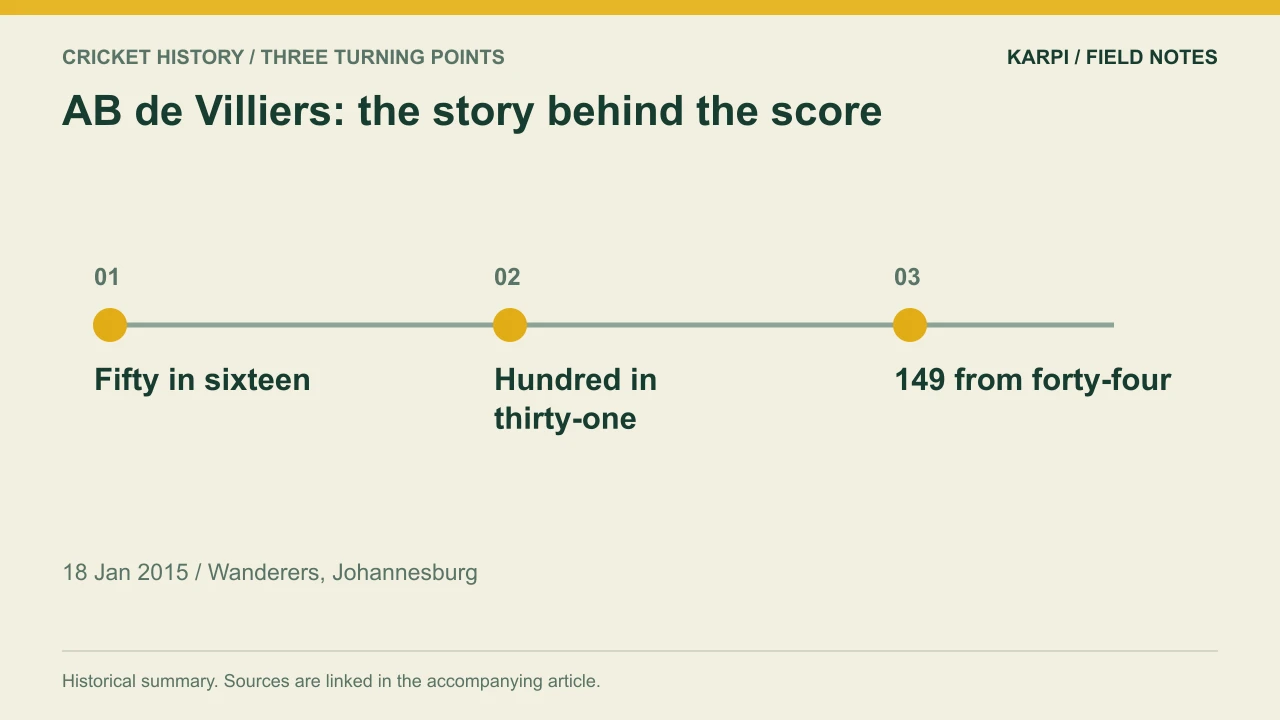
The record is an innings shape, not one shot
A thirty-one-ball target is long enough to require several decisions after an imperfect contact. You cannot judge the attempt only by its opening boundary. The useful question is whether your scoring pattern keeps the remaining requirement manageable. This makes the scenario a different kind of pressure from a two-ball finish: there is time to recover, but also time to waste through repeated small errors.
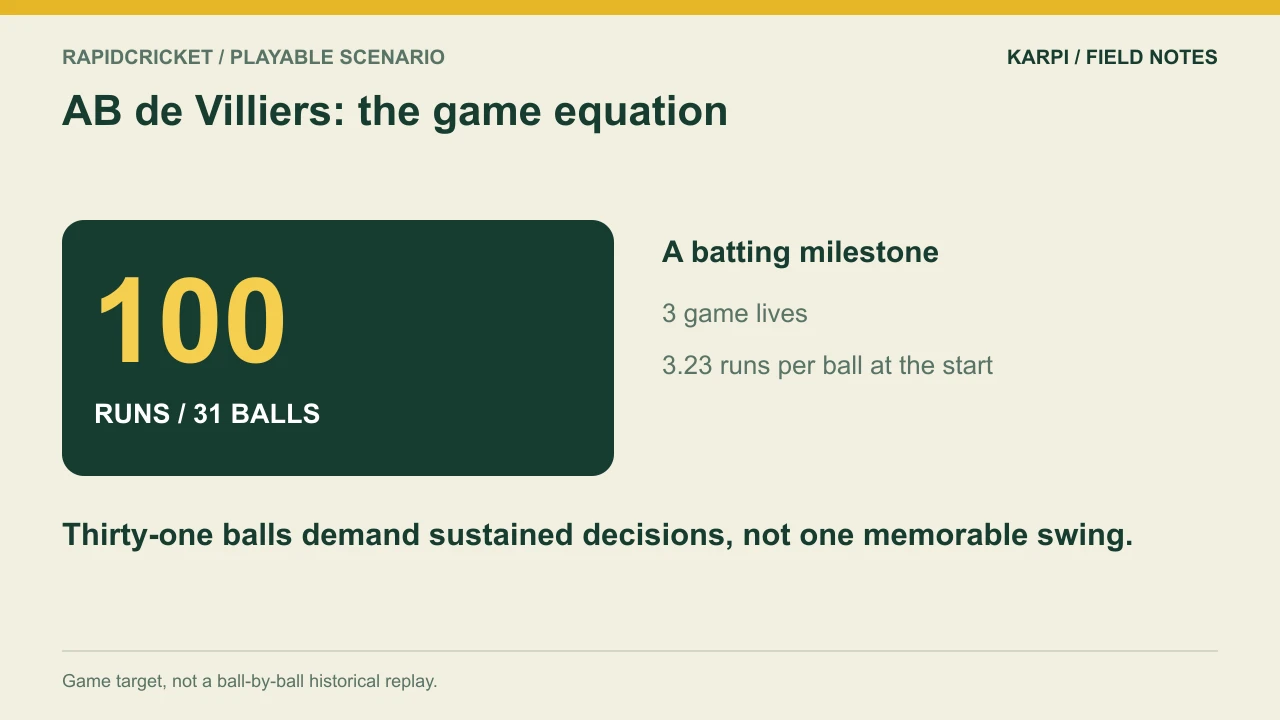
Step into the game scenario
The game asks for one hundred from thirty-one against West Indies pace and spin, with three game lives. Those lives are an arcade allowance, not a historical scorecard detail. Read the changing delivery and choose a direction before timing the shot. Use the runs-and-balls counter to judge progress. A big hit helps, but a sequence of clean contacts matters more than trying to imitate every angle associated with de Villiers.
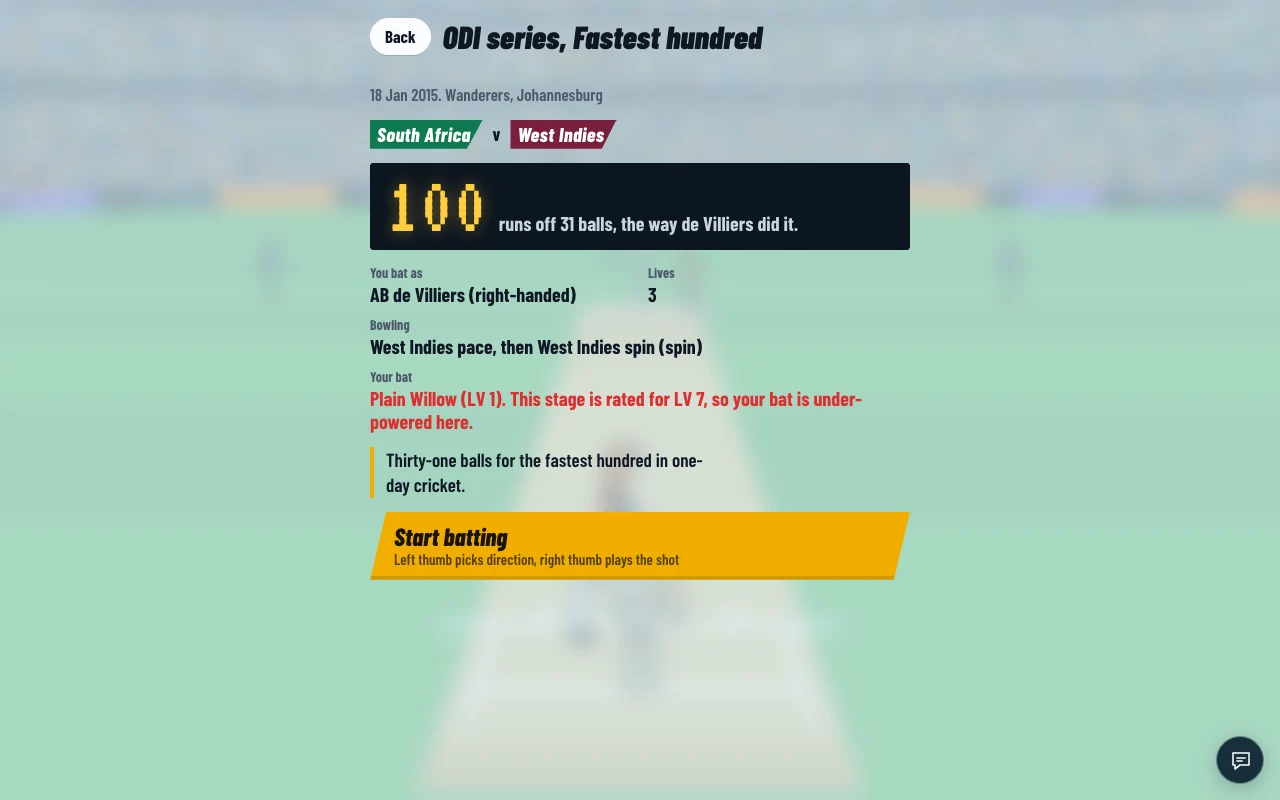
In this game challenge | Starting value |
|---|---|
Target | 100 runs in 31 balls |
Format | Batting feat inspired by the innings |
Game lives | 3 |
Rated bat level | 7 |
Before the first ball
The left controls choose leg, straight or off; the right controls choose defend, drive or loft. The brief shows your equipped bat against the scenario's rating. A lower-rated bat can make a demanding boundary target harder, so use that information when judging a missed attempt. The numbers in the table are the game's starting conditions; its lives, delivery sequence and progression are not a historical scorecard.
After each group of six balls, estimate the remaining runs per ball. Keep the next adjustment specific: fewer early swings, clearer direction selection or better recognition of the new bowler.
Try this finish: Play the AB de Villiers scenario. If it is ahead of your career progress, the link opens an exhibition: you use your own bat and kit, and it does not advance the career or award diamonds. An already-open stage follows normal career rules.
 Take it to the gameRapidCricketReal last-over finishes, two thumbsPlay free
Read next
Kevin O'Brien's 2011 Hundred: The Chase That Stopped Looking Impossible For the series starting point, read Dhoni's 2011 World Cup Six: Four Runs From History.