 KarpiGames Editorial
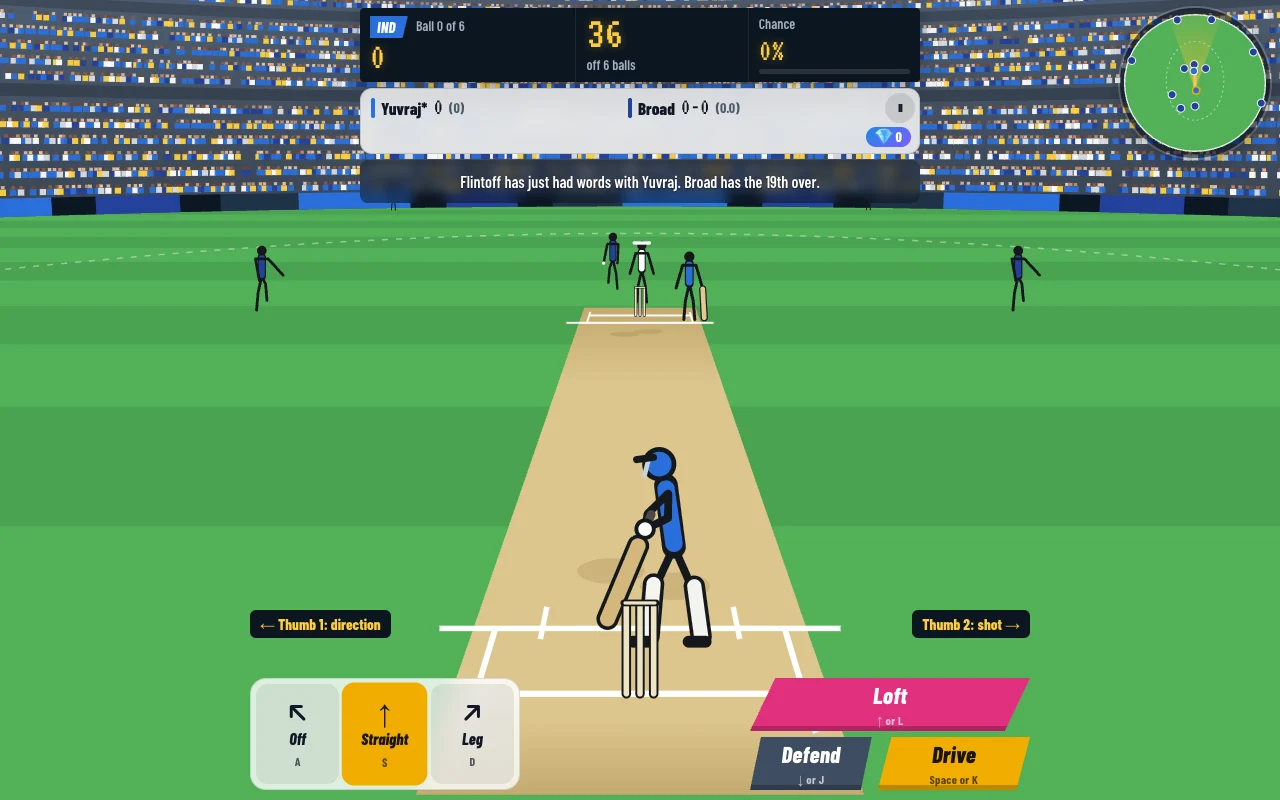
Game recreation captured locally; this is not an archival match photograph.
Six deliveries, six trips beyond the rope. Yuvraj Singh's over against Stuart Broad in Durban in 2007 is remembered as a single eruption, but it was six separate contacts that all found the maximum result.
What happened in the real match
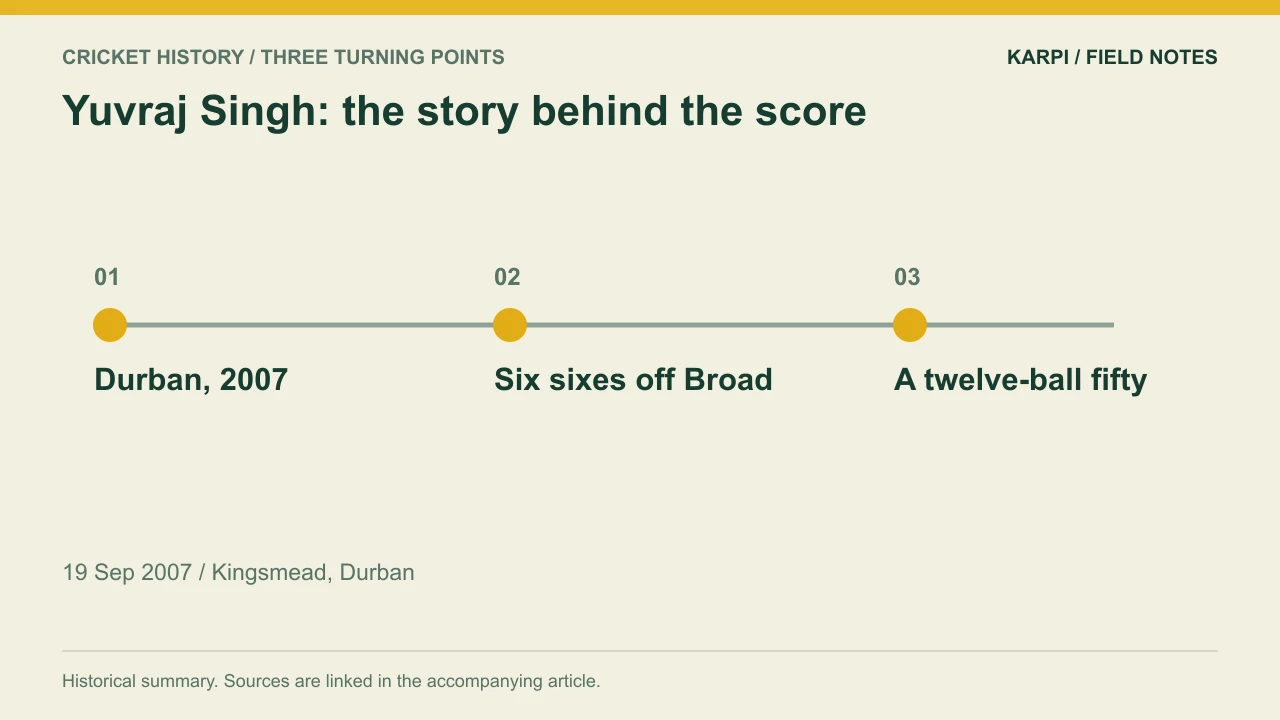
Yuvraj hit Broad for six sixes in an over during India's World Twenty20 match against England at Kingsmead. The burst formed part of a fifty reached in twelve balls, a record at the time. India won the match and later won the tournament. The over became one of the defining images of the inaugural men's World Twenty20: a short sequence whose complete scoreline needs no explanation. ICC's account of Yuvraj's 2007 hitting.
Thirty-six allows no ordinary shortfall
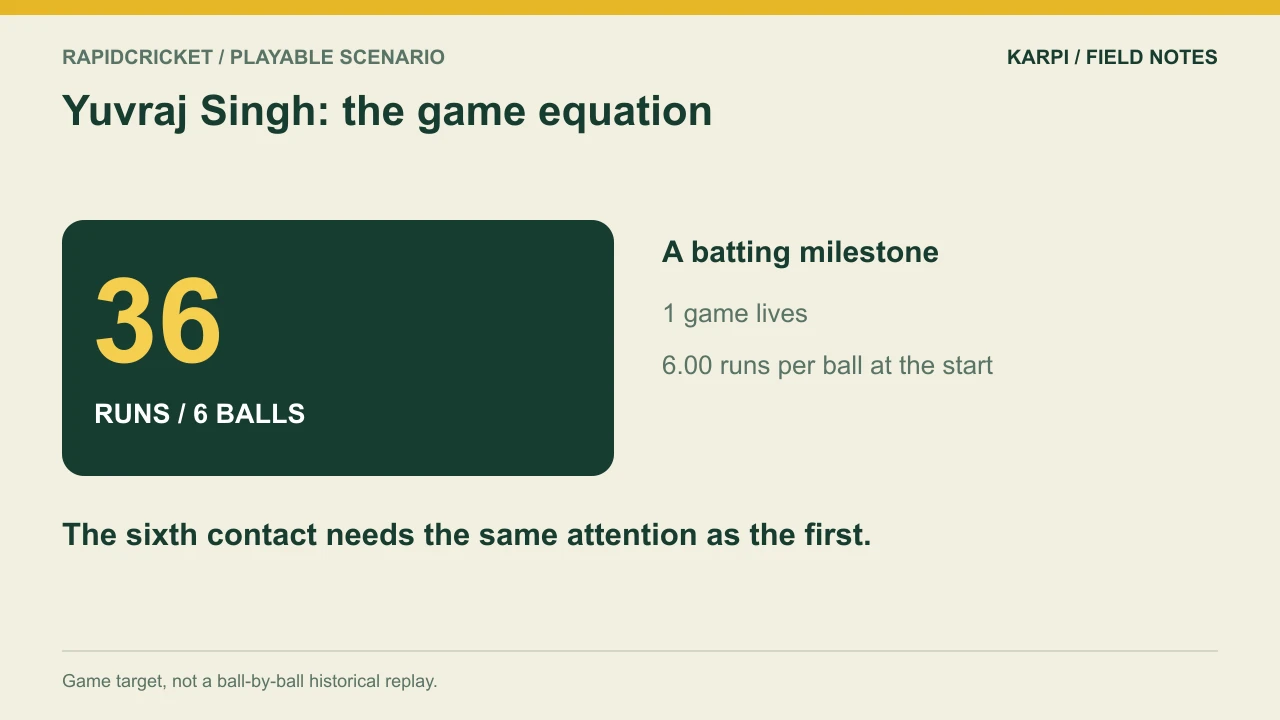
The feat's arithmetic is unusually severe. Six sixes make thirty-six; replacing even one with a four makes thirty-four. Without extras, a thirty-six-from-six challenge has no spare run below a perfect maximum sequence. This is why the last delivery can feel different from the first even when the target per ball appears unchanged: the accumulated success adds something you now have to preserve.
Step into the game scenario
The game uses a 36-from-six feat against Broad with one life. LOFT is the relevant attacking tool, but the button is not an automatic six. Watch the delivery and choose the direction from the field. After each successful hit, reset your attention. A repeated action can be useful; a repeated assumption about timing can make the next ball fail.
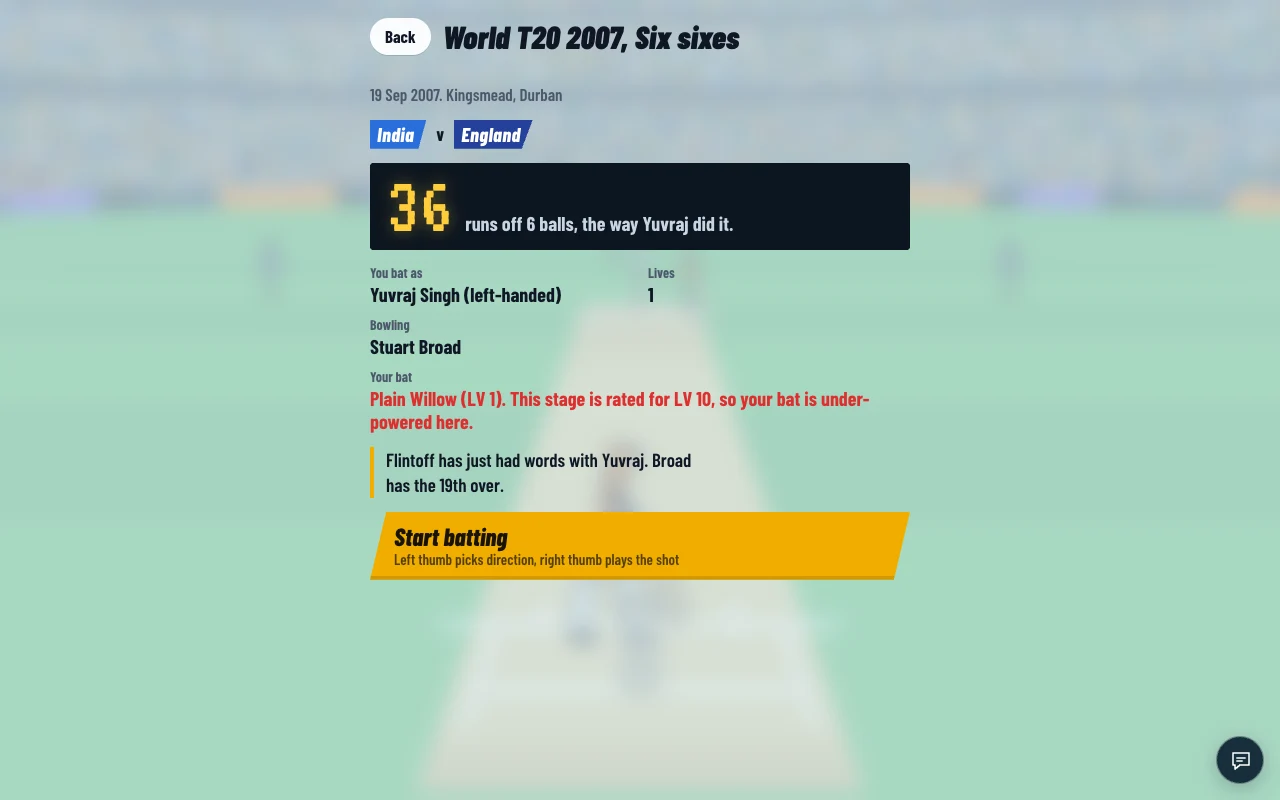
In this game challenge | Starting value |
|---|---|
Target | 36 runs in 6 balls |
Format | Batting feat inspired by the innings |
Game lives | 1 |
Rated bat level | 10 |
Before the first ball
The left controls choose leg, straight or off; the right controls choose defend, drive or loft. The brief shows your equipped bat against the scenario's rating. A lower-rated bat can make a demanding boundary target harder, so use that information when judging a missed attempt. The numbers in the table are the game's starting conditions; its lives, delivery sequence and progression are not a historical scorecard.
Count clean contacts rather than imagining the finished six-six sequence before starting. After a miss, identify the first timing or direction decision that differed from your intention.
Try this finish: Play the Yuvraj Singh scenario. If it is ahead of your career progress, the link opens an exhibition: you use your own bat and kit, and it does not advance the career or award diamonds. An already-open stage follows normal career rules.
 Take it to the gameRapidCricketReal last-over finishes, two thumbsPlay free
Read next
Gibbs' Six Sixes: The World Cup Over With No Small Score For the series starting point, read Dhoni's 2011 World Cup Six: Four Runs From History.