 KarpiGames Editorial
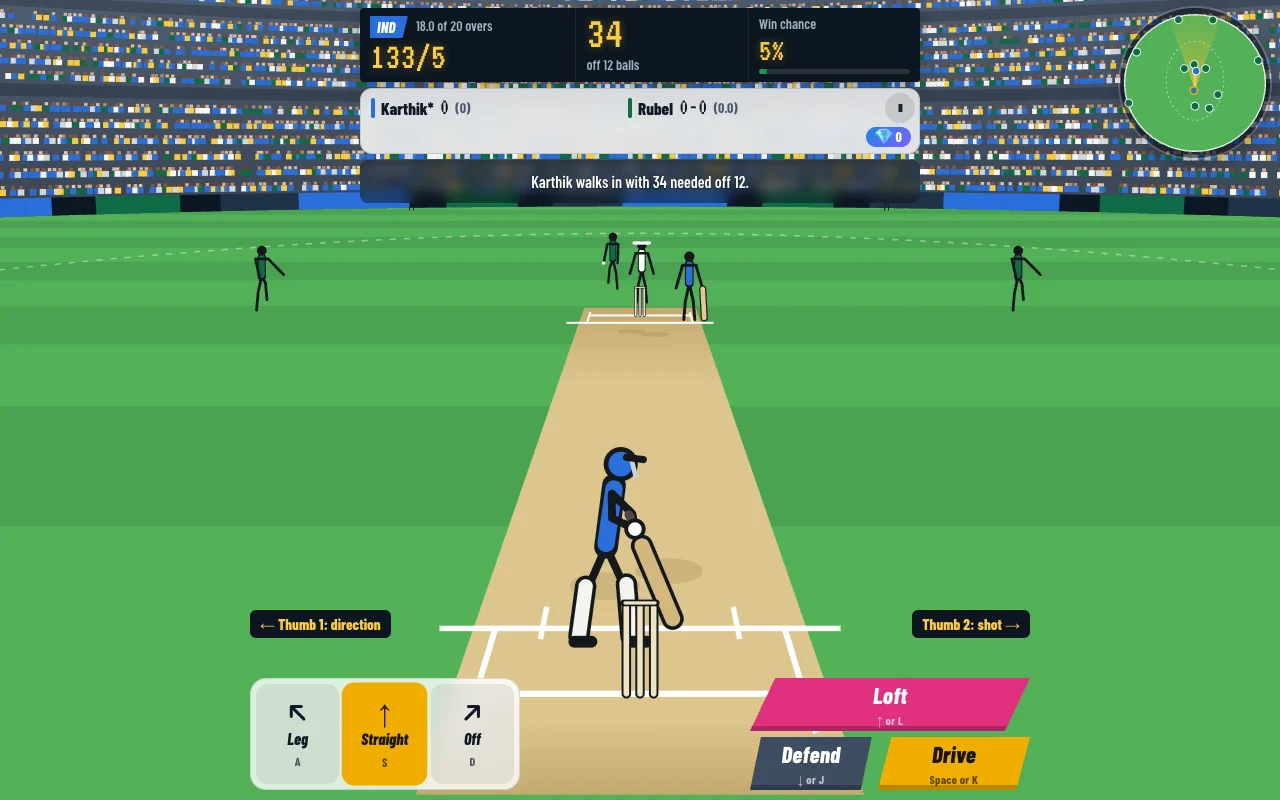
Game recreation captured locally; this is not an archival match photograph.
Dinesh Karthik faced eight balls in the 2018 Nidahas Trophy final and made them enough. His last-ball six is the finish everyone remembers, but the burst before it is what turned a nearly lost chase back into a final-delivery possibility.
What happened in the real match
India needed 34 from the last twelve balls against Bangladesh in Colombo. Karthik arrived and took 22 from Rubel Hossain's over. The final over still left India needing five from the last ball, which Karthik sent over the cover boundary off Soumya Sarkar. His unbeaten 29 from eight balls gave India a four-wicket victory. The cameo combined immediate acceleration with a final shot that had no room for a merely good result. ICC's Nidahas Trophy final report.
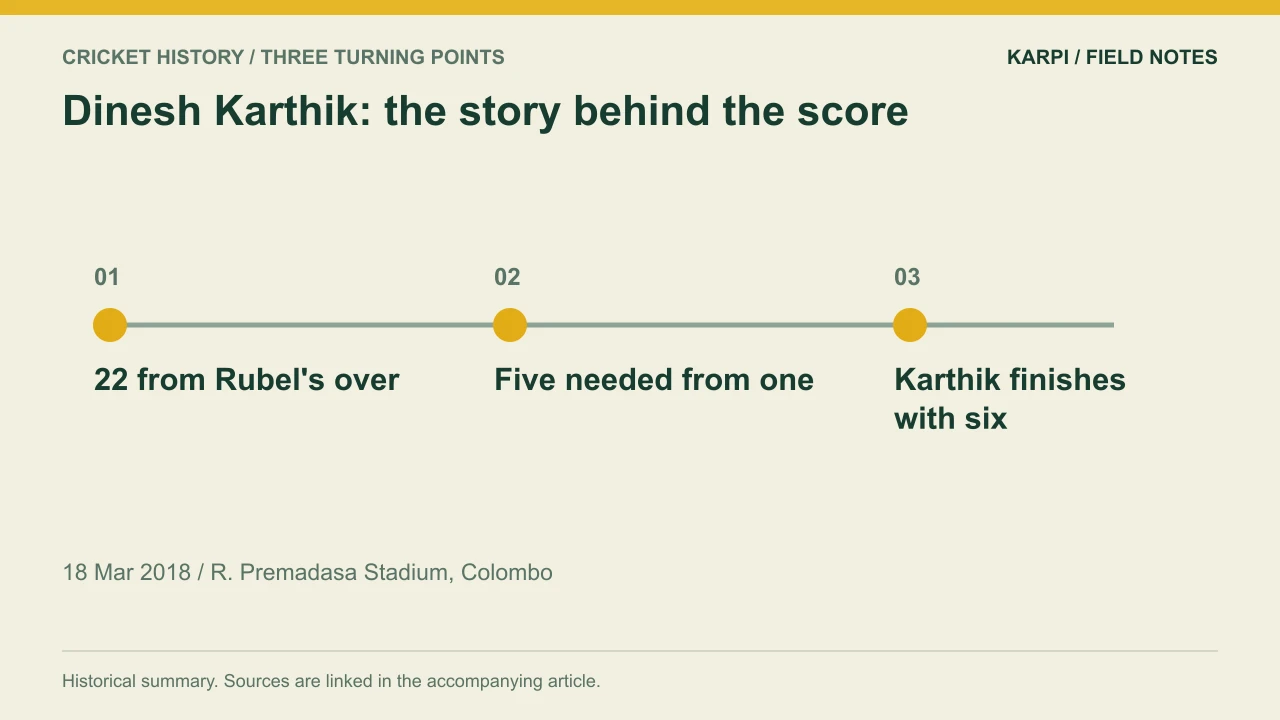
The penultimate over created the last-ball chance
It is tempting to reduce the match to one swing. Yet a last-ball six can only win if the earlier scoring leaves a reachable target. The scenario begins before that final equation, giving you a chance to experience the preparation as well as the finish. A productive first over buys options; an unproductive one can leave a demand that clean ordinary boundaries cannot meet.
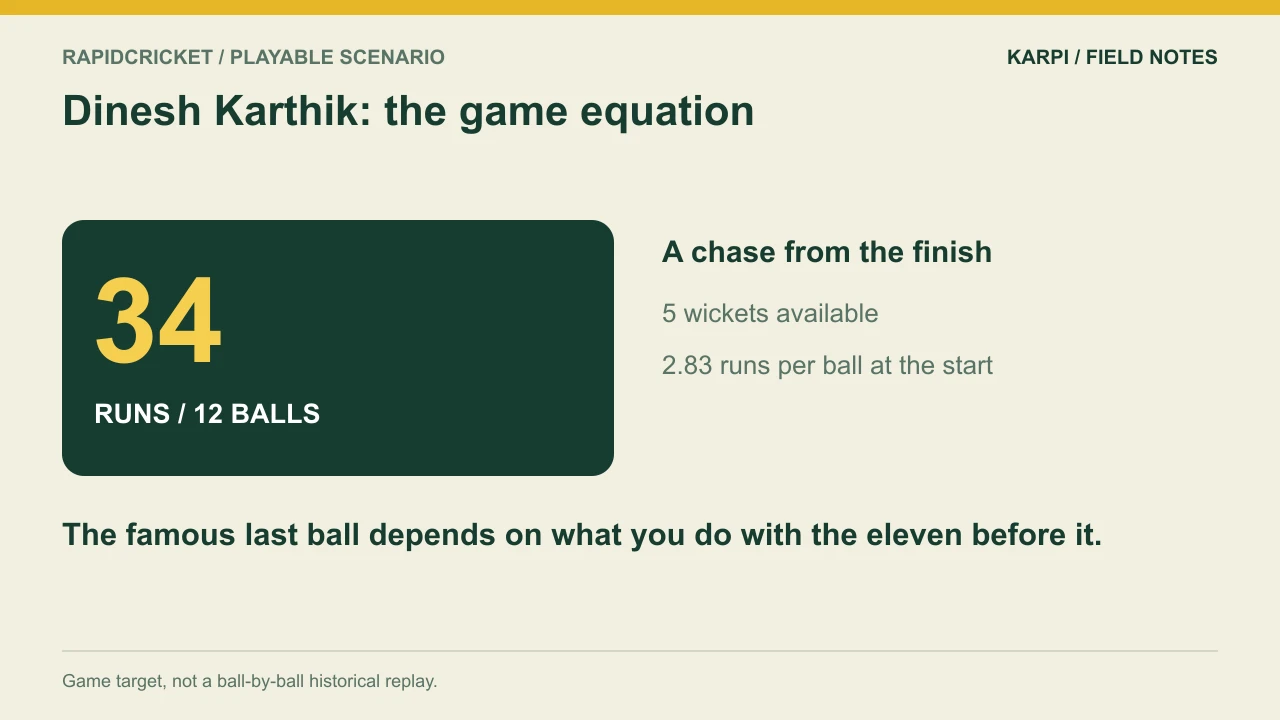
Step into the game scenario
The game asks for 34 from twelve with Rubel and Sarkar in the bowling sequence. Aim to build a scoring rhythm from the first delivery, but keep reading each ball. Use the field map when choosing leg, straight or off. If the first over goes well, recalculate rather than assuming the final over must resemble history. The objective is to complete the chase under the game's rules, not reproduce Karthik's personal eight-ball score.
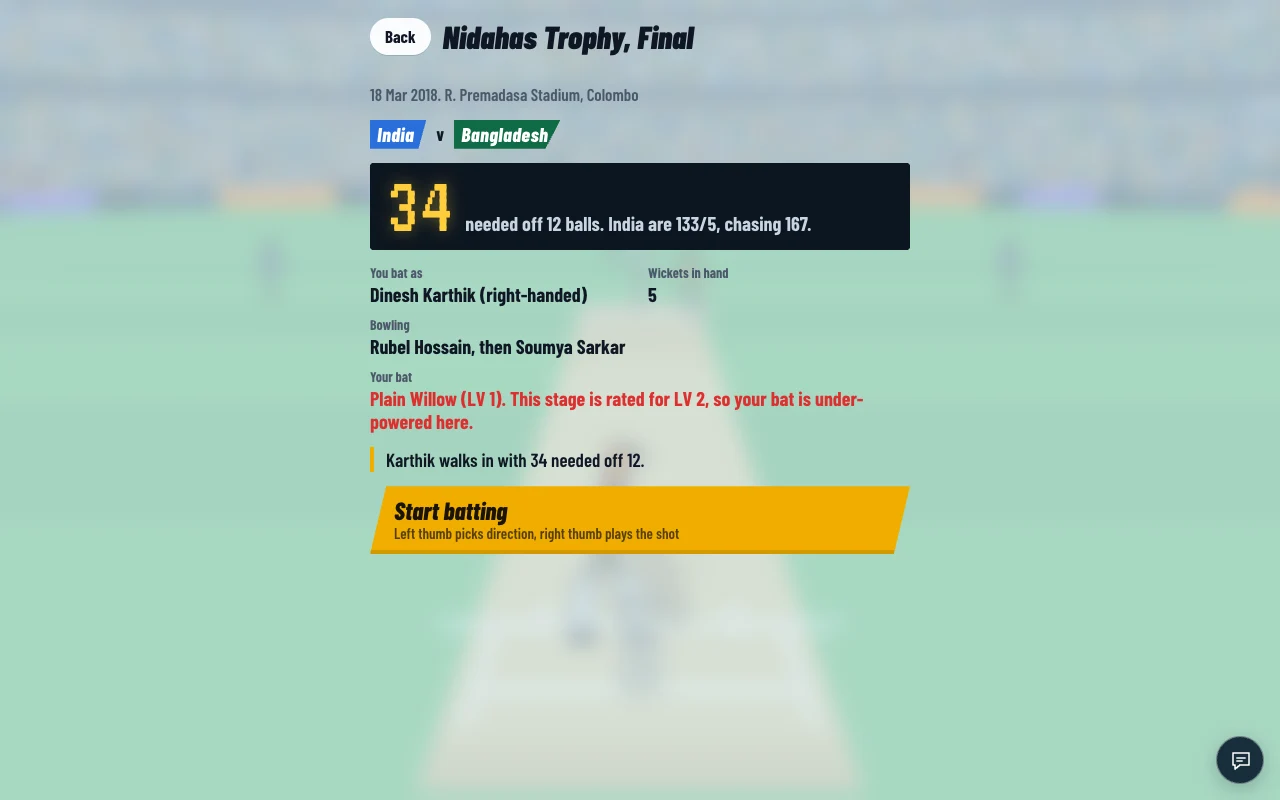
In this game challenge | Starting value |
|---|---|
Target | 34 runs in 12 balls |
Format | Chase inspired by the finish |
Wickets available | 5 |
Rated bat level | 2 |
Before the first ball
The left controls choose leg, straight or off; the right controls choose defend, drive or loft. The brief shows your equipped bat against the scenario's rating. A lower-rated bat can make a demanding boundary target harder, so use that information when judging a missed attempt. The numbers in the table are the game's starting conditions; its lives, delivery sequence and progression are not a historical scorecard.
Compare two attempts by their position at the halfway point. Note the remaining target and which timing errors cost you scoring opportunities. Then change one part of the first-over approach.
Try this finish: Play the Dinesh Karthik scenario. If it is ahead of your career progress, the link opens an exhibition: you use your own bat and kit, and it does not advance the career or award diamonds. An already-open stage follows normal career rules.
 Take it to the gameRapidCricketReal last-over finishes, two thumbsPlay free
Read next
Elliott vs Steyn: Five Runs, Two Balls, a First Final For the series starting point, read Dhoni's 2011 World Cup Six: Four Runs From History.